Leak Detection in Columbia, SC: A Complete Guide
Home »

Hidden Water Leaks Are Costing Columbia Homeowners More Than They Realize
Leak detection in Columbia, SC is one of the most important — and most overlooked — plumbing services a homeowner or business owner can invest in. A leak you can’t see can silently damage your foundation, spike your water bill, and grow mold inside your walls for months before you notice anything wrong.
Here’s what you need to know right away:
- Signs you may have a hidden leak: unexplained rise in your water bill, damp spots on walls or ceilings, musty odors, or the sound of running water when everything is turned off
- What professionals do: use non-invasive tools like acoustic sensors, thermal imaging, and pressure testing to find leaks without tearing up your home
- Who to call: a licensed plumber with leak detection experience in the Columbia, SC area
- What it prevents: mold growth, structural damage, and hundreds of dollars in wasted water every year
- First step if you suspect a leak: turn off your main water supply and call a professional — do not attempt to dig or open walls yourself
Even a small, slow leak can waste thousands of gallons of water per month. In Columbia’s humid climate, that moisture doesn’t just disappear — it soaks into drywall, flooring, and your home’s foundation.
The good news? Modern leak detection technology means specialists can find the exact location of a leak quickly and accurately, often without any major demolition.

Why Early Water Leak Detection is Crucial
Ignoring a suspected water leak is a gamble that rarely pays off. In our experience serving Columbia SC, we have seen minor plumbing issues quickly escalate into major structural nightmares.
When water escapes from a pressurized pipe behind a wall or beneath a floor, it doesn’t just sit there. It wicks into drywall, warps hardwood floors, saturates insulation, and creates a breeding ground for toxic mold. Within 24 to 48 hours of exposure to moisture, mold spores can begin to colonize, posing significant health risks to your family or employees.
Furthermore, structural damage is a very real threat. Water can slowly rot wooden framing, decay crawl space joists, and even erode the soil supporting your concrete foundation.
By the time you see physical evidence of water, the damage has likely been accumulating for weeks. Investing in timely leak detection is the single best way to protect your property and keep your hard-earned money from literally washing down the drain.
Common Signs of Hidden Water Leaks
How do you know if you have a hidden plumbing leak? Because water pipes are tucked away behind walls, under floors, and beneath concrete slabs, you have to play detective. Keep an eye and an ear out for these common warning signs:
- Unexplained Spikes in Your Water Bill: If your water usage habits haven’t changed, but your monthly bill is steadily climbing, a hidden leak is almost always the culprit.
- Musty, Damp Odors: Trapped water will eventually sour. If you notice a persistent musty smell in closets, bathrooms, or your crawl space, moisture is pooling nearby.
- The Sound of Running Water: If you hear water rushing, hissing, or trickling behind your walls when all faucets, showers, and appliances are turned off, water is escaping from your plumbing system.
- Unexplained Damp Spots or Stains: Discolored patches on your ceiling, bubbling paint on baseboards, or soft, spongy spots on your flooring indicate active water damage.
- Water Meter Movement: You can easily check this yourself. Turn off every water fixture in your house and walk out to your water meter box. If the low-flow indicator (often a small red or blue triangle or dial) is spinning, water is actively leaking somewhere on your property.
If you do locate a visible leak at a fixture, learning how to fix a leaking faucet can save some water, but hidden leaks deep within your walls require professional intervention.
How Soil and Climate in the Midlands Cause Plumbing Failures
The geology and weather patterns of the South Carolina Midlands play a massive role in how and why plumbing systems fail. Columbia is famous for its dense, heavy Piedmont red clay soil. This clay is highly expansive, meaning it acts like a sponge. When it rains, the clay absorbs water and swells; during dry hot spells, it shrinks and cracks.
This constant shifting puts immense mechanical torque on buried water and sewer lines. Over time, this shifting soil can pull pipe joints apart, crack rigid lines, and cause underground fittings to fail. To make matters worse, dense red clay acts like a seal. When an underground pipe leaks, the clay often prevents the water from rising straight up to the surface. Instead, the water pools under your concrete slab or travels horizontally along your foundation, showing up far away from the actual break.
Additionally, Columbia’s humid subtropical climate and hot summers accelerate these issues. High humidity prevents trapped moisture from drying out naturally, meaning even a tiny crawl space leak will rapidly lead to wood rot and mold. Seasonal temperature swings also cause pipes to expand and contract, putting additional stress on joints. Understanding what are the top causes of water line damage can help you protect your home from these harsh local environmental conditions.
Professional Leak Detection Columbia SC: What to Expect
If you suspect a leak, you might worry that a plumber will have to tear open your drywall or jackhammer your concrete floors just to find the problem. Fortunately, those days are long gone.
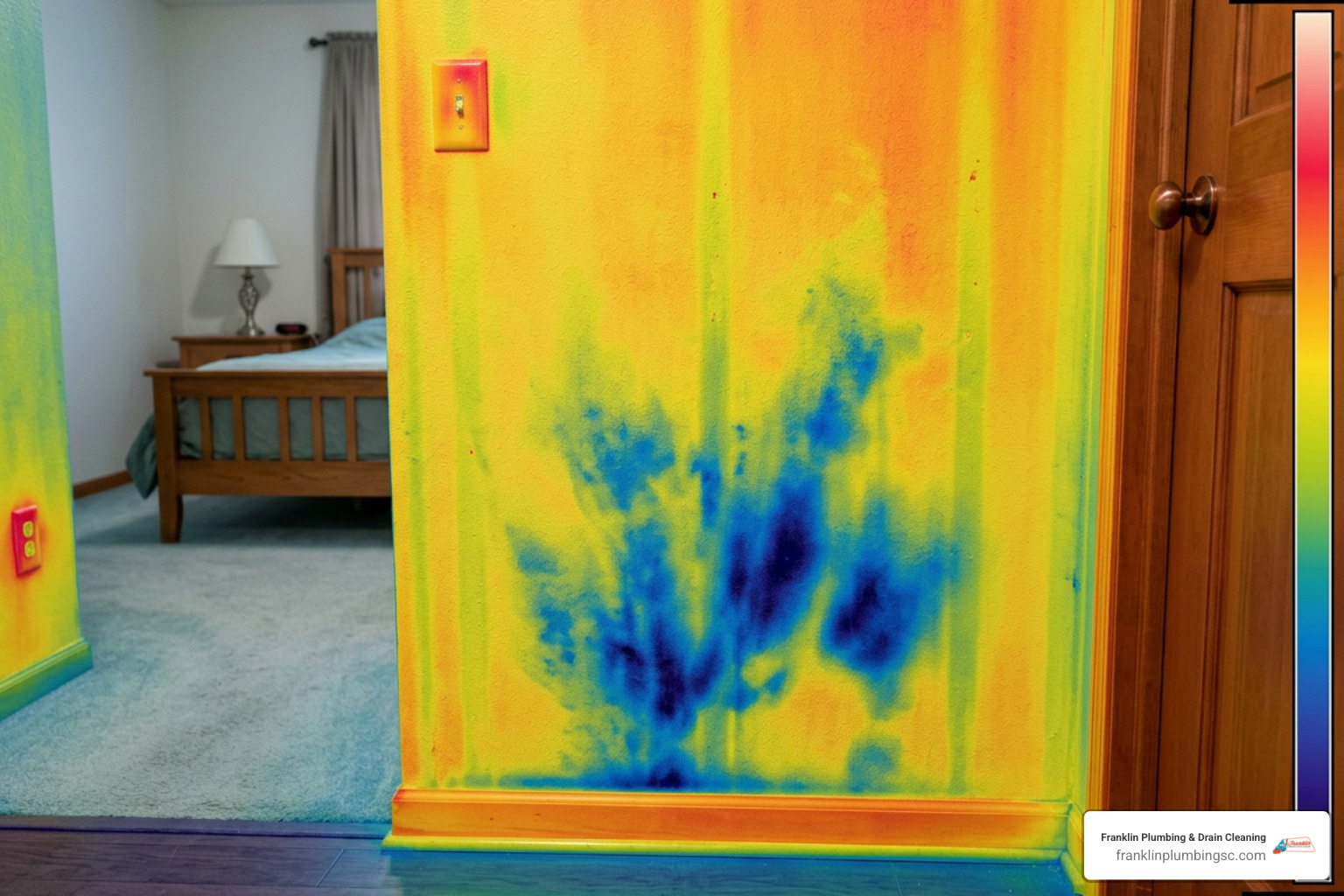
When we perform leak detection in Columbia, SC, we utilize advanced, non-invasive technology to pinpoint the exact location of the breach down to the inch before making a single cut.
Our specialized process involves a combination of high-tech tools:
- Acoustic Listening Devices: Pressurized water escaping from a pipe creates distinct ground vibrations and high-frequency sounds. Using highly sensitive microphones and acoustic sensors, we can listen through concrete, soil, and walls to locate the exact point of the leak.
- Thermal Imaging Cameras: Water changes the temperature of surrounding building materials. Infrared cameras allow us to “see” through walls and floors by displaying temperature differentials, instantly mapping out hidden moisture plumes.
- Moisture Meters: These tools measure the moisture content in drywall, wood, and plaster, helping us track the path of the water back to its source.
- Leak Noise Correlators: For longer pipe runs, specialized sensors are placed at two different access points on the pipe. By measuring the time it takes for the sound of the leak to reach each sensor, a computer can calculate the exact location of the break.
Non-Invasive Methods for Under-Slab and Concrete Scanning
Slab leaks—leaks that occur in the water lines running beneath your home’s concrete foundation—are among the trickiest to deal with. If a technician simply guesses where the leak is, they could end up excavating massive portions of your living room floor.
To prevent this, advanced subsurface visualization is used. For complex commercial structures or post-tension concrete slabs, high-resolution concrete scanning is employed. In the utility and construction industries, concrete scanning achieves a 99.8%+ accuracy rate for post-tension concrete imaging, ensuring that any embedded cables or conduits are completely avoided during any eventual repairs.
For residential homes, we combine acoustic sensors with electronic pipe path locators. This allows us to map the exact layout of your under-slab plumbing and pinpoint the failing joint without disturbing your hardwood, tile, or carpeted floors.
Smart Water Monitoring and Acoustic Leak Detection Columbia SC
Technology has also paved the way for proactive, 24/7 protection. Many homeowners in the Midlands are now opting for smart water monitoring systems, such as StreamLabs technology. These smart devices are installed on your main water line and constantly measure water flow, temperature, and pressure changes.
If the system detects a micro-leak or an unusual continuous flow of water, it sends an instant alert to your smartphone. Some advanced models can even automatically shut off your main water valve to prevent catastrophic flooding while you are away from home.
When combined with professional acoustic sensors during an inspection, these smart systems ensure your home is fully fortified against water damage.
Comparing Slab Leaks, Pool Leaks, and Irrigation Leaks
Not all plumbing leaks are created equal. Depending on where the water line is located, the detection methods, potential risks, and repair strategies vary significantly.
Slab leaks, pool leaks, and irrigation leaks each call for different detection tools and repair methods. Slab leaks are often found with acoustic sensors, thermal imaging, and pressure testing, especially when homeowners notice warm spots on the floor, a spinning water meter, or damp baseboards. Left alone, they can lead to foundation shifting, cracked concrete, and wall damage, and repairs may involve under-slab tunneling, pipe rerouting, or epoxy lining. Pool leaks are commonly traced with sonar equipment, dye testing, and pressure rigs; warning signs include dropping water levels, soggy ground near the pool, and chemical imbalances. These leaks can cause soil erosion, deck cracking, or even sinkholes, with repairs ranging from shell patching to plumbing line replacement. Irrigation leaks are usually detected with ground-penetrating radar or acoustic listening equipment and often show up as saturated lawn patches, low sprinkler pressure, or unusually high utility bills. If ignored, they can wash out soil, kill plants, and ruin landscaping, so damaged PVC sections are typically trenched and replaced.
Slab Leaks and Under-Slab Water Line Repair
Slab leaks are particularly dangerous because they directly threaten the structural integrity of your home. When water continuously sprays under a concrete slab, it can wash away the supporting soil. This causes the heavy concrete to sink, crack, and shift, leading to misaligned doors, cracked drywall, and major structural damage.
If you suspect an under-slab issue, our specialized slab leak repair and water line repair services are designed to address the problem with minimal disruption. Depending on the age of your pipes and the location of the break, we can either bypass the leaking line entirely by routing a new pipe through your walls and attic, or perform a localized repair by carefully opening a small, targeted access point in the slab.
Pool and Irrigation System Leak Detection Columbia SC
Outdoor leaks can be just as costly as indoor ones, but they are often harder to spot. If you have an outdoor swimming pool, a gradual drop in the water level might seem like normal evaporation. However, if you are losing more than a quarter-inch of water a day, you likely have a pool leak.
Pool leaks typically stem from structural cracks in the pool shell or failures in the underground plumbing lines (like the skimmer, return, or main drain lines). Specialists use specialized sonar equipment and localized dye testing around fittings to find these underwater breaches without draining your pool.
Similarly, irrigation leaks can waste massive amounts of water. Because sprinkler lines run underground throughout your yard, a broken pipe can leak thousands of gallons into the soil before creating a visible puddle.
These outdoor water main issues are incredibly common in our area. For instance, in late 2025, persistent Forest Acres water main leaks made local headlines as water main failures frustrated neighbors and caused significant water waste across local communities. Whether the leak is in your front yard irrigation system or a main supply line, getting it located and repaired quickly is essential to prevent soil erosion and massive utility bills.
Frequently Asked Questions About Leak Detection
Can leak detection and repair be done in one visit?
Yes! Unlike some national companies that only locate leaks and leave you to find your own plumber to fix them, we provide a comprehensive, single-source solution.
Our licensed, experienced plumbers are fully equipped to both locate the leak using our advanced non-invasive tools and perform the necessary repairs during the very same visit.
Whether it requires a simple pipe patch, a localized wall repair, or a complete sewer water line replacement, we handle the entire process from start to finish to restore your peace of mind as quickly as possible.
What areas around the Midlands do local specialists serve?
We are proud to serve homeowners and businesses throughout the entire Greater Columbia area and surrounding Midlands communities. Our service area includes:
- Columbia, SC
- West Columbia, SC
- Lexington, SC
- Irmo, SC
- Chapin, SC
- Blythewood, SC
- Cayce, SC
- Elgin, SC
- Forest Acres, SC
- Springdale, SC
- South Congaree, SC
- Dentsville, SC
- Pontiac, SC
- St. Andrews, SC
- Arcadia Lakes, SC
No matter where you are located in the Midlands, our team is ready to respond with rapid, reliable service.
What should homeowners do immediately if they suspect a hidden leak?
If you suspect a hidden water leak on your property, taking immediate action can save you thousands of dollars in water damage repairs:
- Shut Off the Main Water Valve: Locate your home’s main water shut-off valve (usually located in your utility room, crawl space, or out near the street in a green meter box) and turn it off. This stops the flow of pressurized water and halts active flooding.
- Move Your Valuables: If you notice damp carpet or water stains on walls, immediately move furniture, electronics, and valuables out of the affected area to prevent ruin.
- Avoid DIY Excavation: It can be tempting to grab a shovel or a drywall saw to find the leak yourself. However, without professional tools, you risk cutting other utility lines. That 60% of all utility lines are private, not public, and standard 811 locates only public utilities without providing their depths. Attempting to dig blindly can result in severe damage to gas, electrical, or communication lines.
- Call a Professional Plumber: Contact a licensed leak detection specialist immediately. We can help you determine if high municipal water pressure is stressing your system and explain how excessive water pressure affects your house plumbing, which often triggers these sudden pipe failures.
Conclusion
A hidden water leak is a ticking clock. The longer it goes undetected, the more damage it inflicts on your home’s structure, your health, and your wallet. At Franklin Plumbing & Drain Cleaning, we combine state-of-the-art non-invasive leak detection technology with the hands-on expertise of our licensed, experienced plumbing technicians.
We stand behind our work with a 100% satisfaction guarantee, ensuring that your home is safe, dry, and fully restored with minimal disruption to your daily life.
Don’t let a hidden leak drain your peace of mind. Schedule professional leak detection today with our friendly local team and protect your Midlands home for years to come!

professional
drain cleaning

highly
recommended

through
repairs

quality
work