Water Heater Repair or Replace in Cayce, SC?
Home »
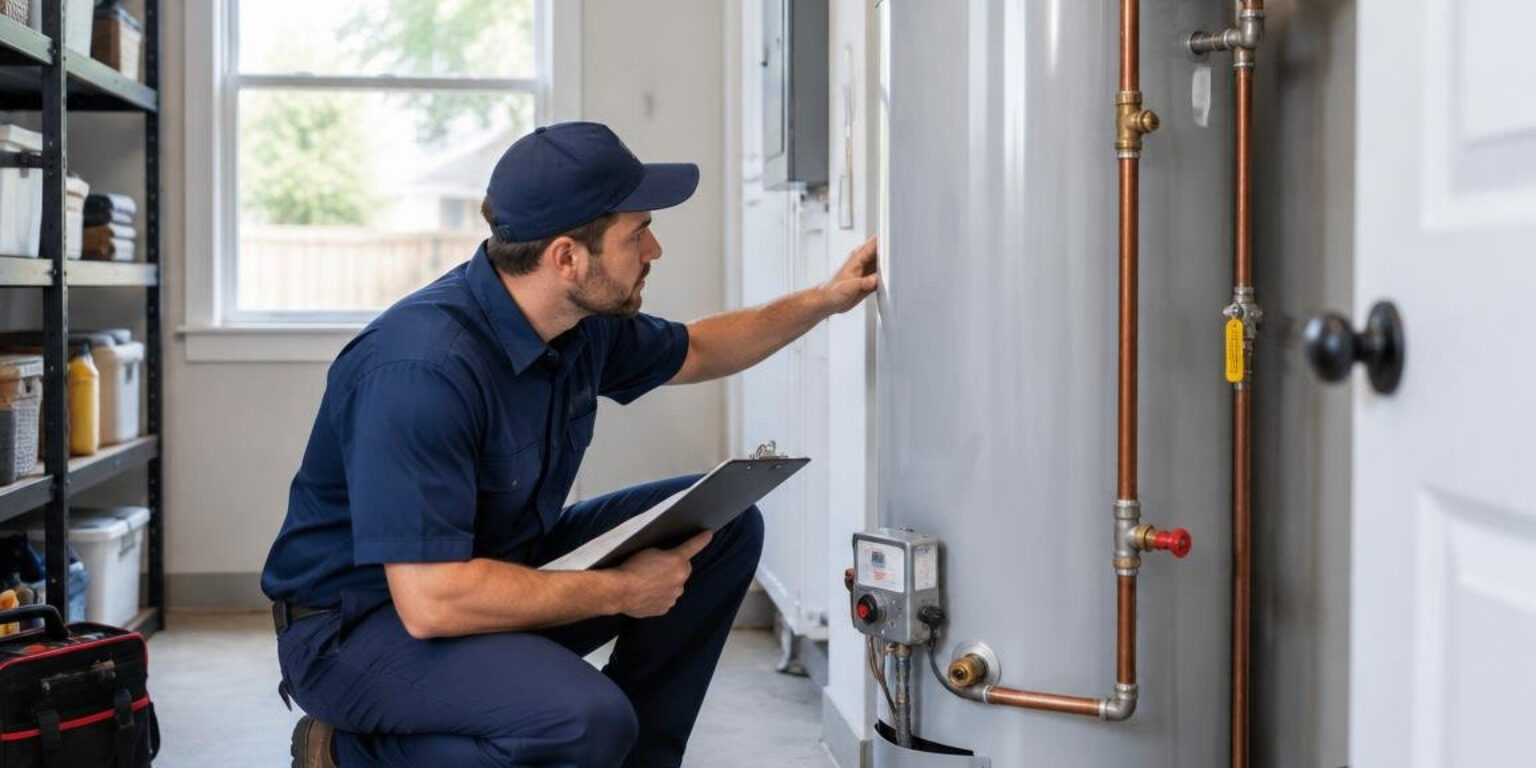
Is It Time to Repair or Replace Your Water Heater in Cayce, SC?
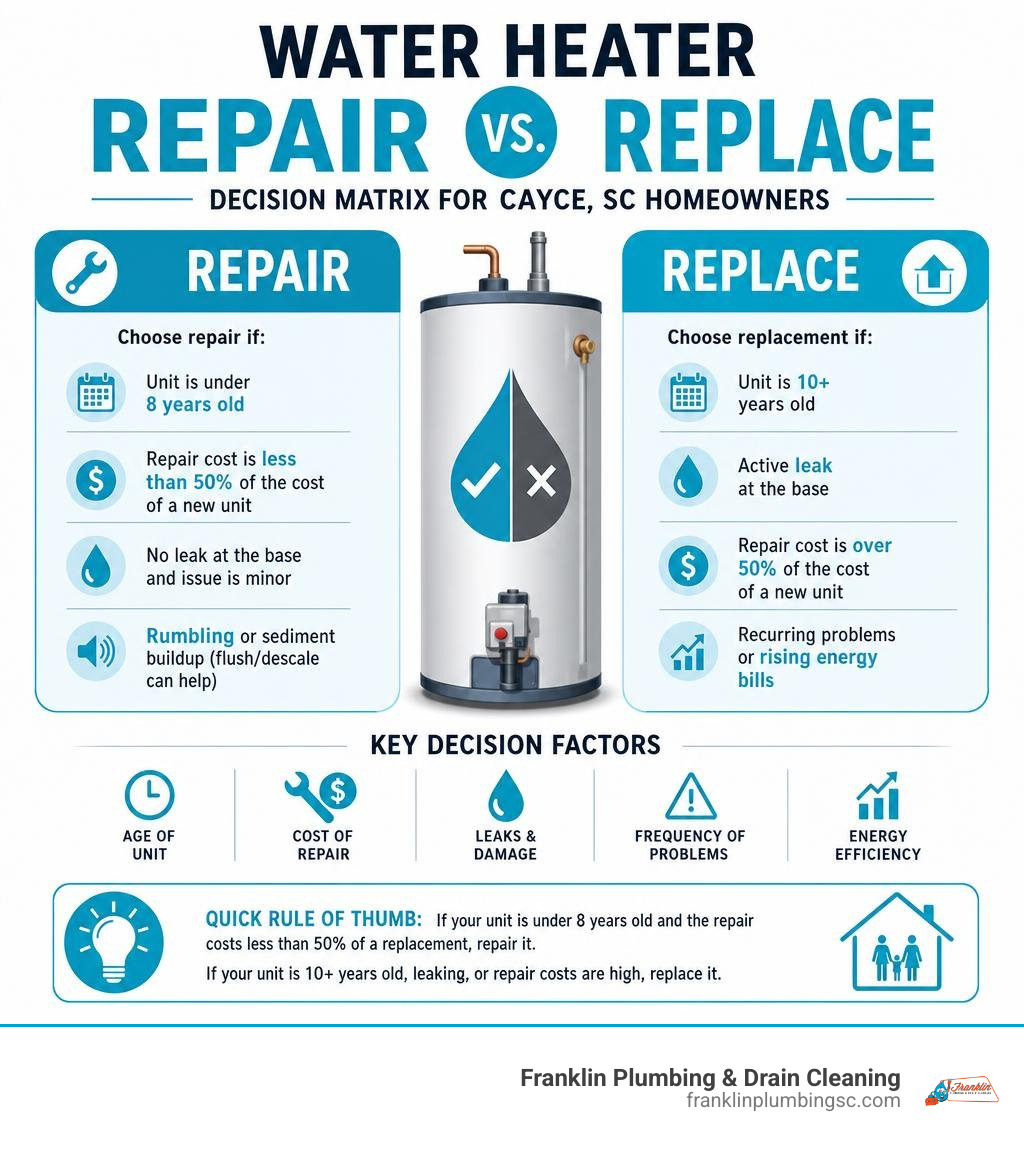
When it comes to water heater repair vs replace in Cayce, SC, the short answer depends on your unit’s age, the type of problem, and what repairs will cost you compared to a new system.
Quick answer for most homeowners:
- Repair if your unit is under 8 years old and the fix costs less than 50% of a replacement
- Replace if your unit is 10+ years old, leaking at the base, or repair costs are climbing toward the price of a new system
Here is a fast reference guide:
| Situation | Recommended Action |
|---|---|
| Unit under 8 years old, minor issue | Repair |
| Repair cost over 50% of replacement | Replace |
| Unit 10+ years old with recurring problems | Replace |
| Active leak at the base of the tank | Replace immediately |
| Rumbling noises, no base leak | Repair (flush/descaling) |
| Rising energy bills, unit over 8 years | Consider replacement |
Nearly 18% of your home’s energy use goes toward heating water. A failing or aging water heater does not just mean cold showers — it quietly drives up your utility bills every single month.
For Cayce, SC homeowners, the decision is often pushed earlier than expected. Hard water, sediment buildup, and the humidity typical of the Midlands region can shorten a water heater’s life well below the national average. Traditional tank units that might last 12 years elsewhere often show signs of wear in 8 to 10 years here.
The good news: knowing what to look for makes the decision much clearer.
Key Signs Your Water Heater Needs Professional Attention
It is easy to ignore your water heater when it is tucked away in a crawlspace, utility closet, or garage. However, your water heater will almost always drop hints before it completely stops working. Recognizing these warnings early can save you from an unexpected cold shower or, worse, a flooded home.
Inconsistent Temperatures and Lukewarm Water
If your morning shower starts out hot but turns ice-cold within minutes, your water heater is struggling. In electric units, this is often caused by a burned-out upper or lower heating element. In gas units, a failing thermocouple or pilot light issue might be the culprit. While these are usually straightforward fixes for our team, a system that consistently fails to maintain temperature might be nearing the end of its useful life.
Rumbling, Popping, or Banging Noises
When you hear strange noises coming from your utility closet, it is not a ghost. It is sediment. Over time, the natural minerals in our local water supply settle at the bottom of the tank. As the burner or heating element heats the water, steam pockets bubble up through this thick layer of hardened sediment, creating loud popping or rumbling sounds. If left unaddressed, this sediment layer acts as a barrier, forcing your water heater to work twice as hard and eventually causing the metal tank to overheat and crack.
Rusty or Discolored Water
If rusty water is coming out of your hot water faucets but your cold water runs perfectly clear, your water heater tank is corroding from the inside out. This usually means the sacrificial anode rod has completely dissolved, leaving the steel tank unprotected. Once the interior walls of a steel tank start rusting, a leak is not far behind.
Active Leaks Around the Base
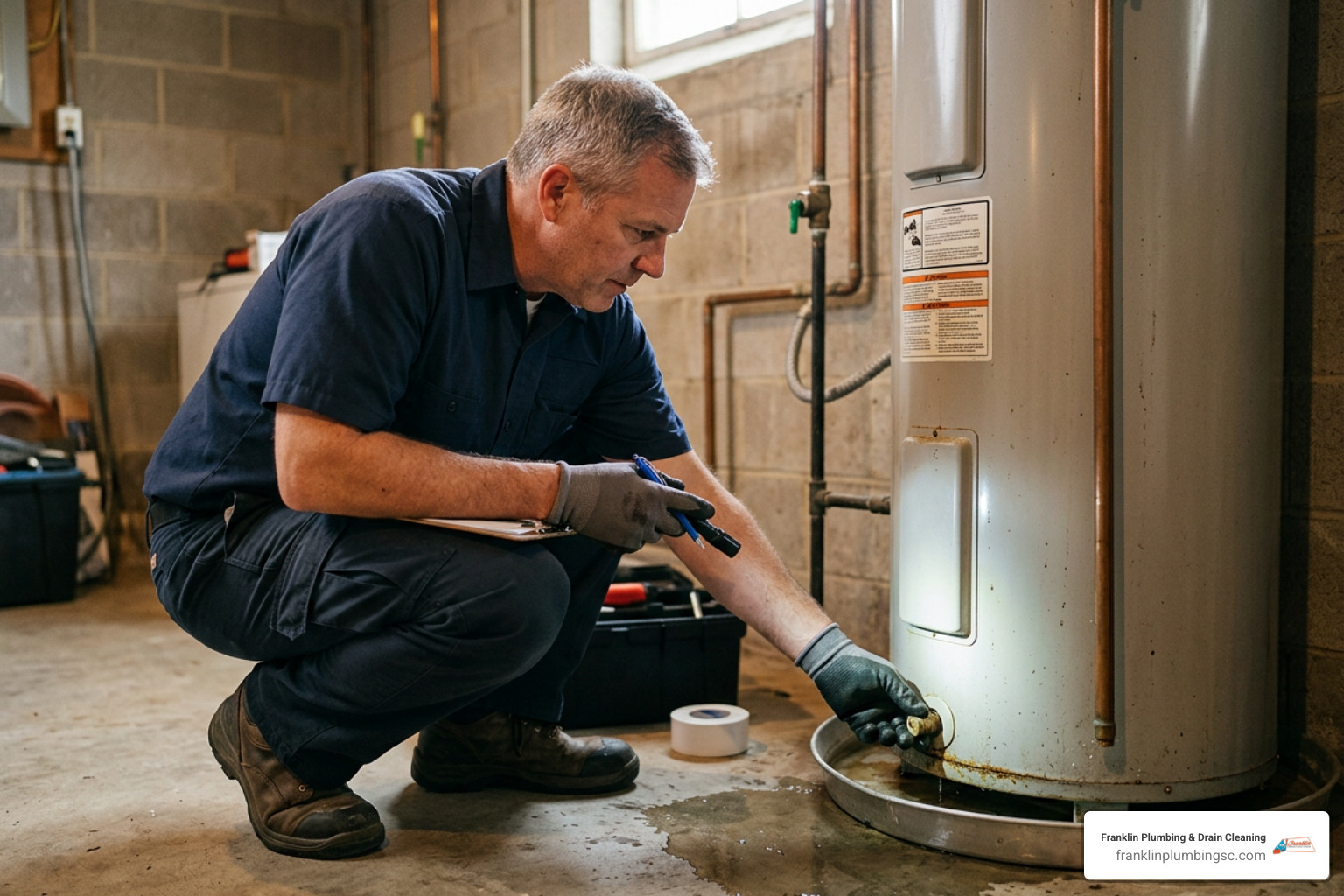
Moisture or standing water around the bottom of your tank is a major red flag. While some leaks come from a loose drain valve or a dripping temperature and pressure relief valve, a leak coming directly from the tank itself cannot be repaired. If the inner lining of the tank has fractured, you need an immediate replacement to prevent catastrophic water damage.
When you notice any of these warning signs, scheduling professional water heater repair services quickly can prevent minor issues from turning into expensive emergencies.
Lifespan Expectations and Local Environmental Factors in Cayce, SC
Nationwide averages suggest that standard tank water heaters last about 8 to 12 years, while tankless systems can last up to 20 years. However, here in the Midlands of South Carolina, our local environment plays a massive role in how long your equipment actually survives.
The Midlands Water Quality Factor
Cayce, SC and surrounding areas like West Columbia, SC and Lexington, SC often experience hard water and high sediment levels. The minerals in our water supply, particularly calcium and magnesium, accelerate scale buildup inside water heating systems. This scale coats heating elements and settles at the bottom of traditional tanks, leading to premature tank failure.
Humidity and Corrosion
Our hot, humid South Carolina summers do more than just make outdoor activities sweaty. High humidity levels, especially in homes near the Congaree River or Lake Murray, can accelerate external corrosion on gas water heater venting systems and tank jackets. When moisture combines with combustion byproducts, it creates a highly corrosive environment that can degrade metal components much faster than in dry climates.
Water Pressure Fluctuations
With the rapid residential growth across Lexington County and the Cayce, SC area, municipal water pressure can fluctuate. High water pressure puts constant physical stress on the inner lining of your water heater tank. Without a properly functioning thermal expansion tank or a pressure reducing valve, this stress leads to tiny fractures in the tank glass lining, paving the way for rust and eventual failure.
To maximize your system’s lifespan and ensure it meets modern efficiency standards, we recommend looking for systems that align with current Energy Star water heater specifications, which are designed to withstand demanding regional conditions while lowering your monthly operating costs.
Water Heater Repair vs. Replace in Cayce, SC: The Cost-Benefit Analysis
Deciding whether to call for a repair or invest in a brand-new water heater comes down to a balance of immediate costs versus long-term savings.
To help you weigh your options, consider this comparison table:
| Decision Factor | Water Heater Repair | Water Heater Replacement |
|---|---|---|
| Upfront Cost | Lower initial cost, typically covering parts and labor. | Higher initial investment for the new unit and professional installation. |
| System Lifespan | Extends the life of your current unit by a few months or years. | Resets your system lifespan to 10 to 15 years, or 20+ for tankless. |
| Energy Efficiency | Efficiency remains the same or continues to decline as the unit ages. | Can lower energy consumption with modern, highly insulated designs. |
| Reliability | Risk of future breakdowns remains, especially on older systems. | High reliability backed by a manufacturer warranty. |
| Warranty Coverage | Repair parts may carry a short warranty, but the overall unit remains uncovered. | Peace of mind with long-term coverage on the tank and components. |
When evaluating these choices, the experienced team at Franklin Plumbing & Drain Cleaning uses the 50% rule: if a single repair costs half as much as a brand-new system, or if the cumulative cost of recent repairs exceeds that threshold, replacing the unit is often the more financially sound choice.
When to Choose Water Heater Repair vs. Replace in Cayce, SC
Repairing your water heater is highly cost-effective when the unit is relatively young, generally under 8 years old, and the problem is isolated to a replaceable component.
Common minor repairs include:
- Replacing a faulty upper or lower thermostat
- Swapping out a burned-out electric heating element
- Installing a new pilot assembly or thermocouple on a gas unit
- Replacing a dripping temperature and pressure relief valve
- Replacing a worn-out drain valve
These fixes are quick, budget-friendly, and can add several years of reliable service to your water heater without the need for a full replacement.
When Replacement is the Smarter Long-Term Investment
While a repair might get your hot water back on today, there are times when continuing to patch up an old system is simply throwing good money away.
Replacement is the logical choice if:
- The tank is actively leaking: A fractured inner tank cannot be welded or sealed.
- The unit is past its prime: If your tank water heater is over 10 years old, its internal components are likely heavily corroded, and its efficiency has dropped significantly.
- You want to lower your utility bills: Modern systems are generally more efficient than those built a decade ago.
- You are tired of running out of hot water: If your family has grown, upgrading to a larger tank or choosing a tankless water heater installation can provide a more dependable supply of hot water for busy households.
Before selecting a replacement size, homeowners can use our water heater sizing guide to compare household demand, fixture use, and the practical differences between tank and tankless options.
Comparing Your Replacement Options: Tank, Tankless, and Hybrid Systems
If you have decided that a replacement is the best path forward, you have several options to consider. Water heater technology has advanced rapidly, giving Cayce, SC homeowners choices that offer efficiency and reliable performance.
Traditional Storage Tank Water Heaters
These are the classic systems most of us grew up with. They keep a large volume of water, usually 40 to 50 gallons, heated constantly so it is ready when you turn on a faucet.
- Pros: Lowest upfront installation cost; familiar technology; works well for high-demand, short-duration usage.
- Cons: Subject to standby heat loss; limited hot water supply; larger physical footprint.
Tankless Water Heaters
Often called on-demand water heaters, these systems only heat water as it flows through the unit. They do not use a storage tank at all.
- Pros: Endless hot water; compact wall-mounted design; can reduce energy use; may last 20 years or more with proper maintenance.
- Cons: Higher initial installation cost; requires annual descaling to combat local hard water; may require gas line or electrical upgrades during installation.
Hybrid Heat Pump Water Heaters
These advanced systems pull heat from the surrounding air and transfer it into the water tank, using significantly less electricity than standard electric water heaters.
- Pros: High energy efficiency; low operating costs; may qualify for federal tax credits and local utility rebates.
- Cons: Requires a larger installation space with adequate airflow; higher upfront cost; works best in warm spaces like garages or unfinished basements.
The team at Franklin Plumbing & Drain Cleaning can explain which system best fits your household’s usage, available space, and installation requirements in Cayce, SC.
The Pros and Cons of a Tankless Water Heater Repair vs. Replace Decision in Cayce, SC
For many homeowners in Cayce, SC, the ultimate decision comes down to choosing between a standard tank replacement or upgrading to a tankless system.
Here is a quick look at the trade-offs:
- The Pros: With a tankless system, you will enjoy a virtually endless supply of hot water, which can be a major benefit for large families. Because these units heat water on demand, you stop paying to keep 50 gallons of water hot while you are asleep or at work. They can also free up valuable floor space in your home.
- The Cons: The primary hurdle is the initial cost. Because tankless units may require specialized venting, gas line adjustments, or dedicated electrical circuits, the installation process can be more complex than simply swapping out a standard tank. Additionally, because Cayce, SC has hard water, tankless systems require annual descaling to help prevent mineral buildup from damaging the heat exchanger.
Frequently Asked Questions About Water Heater Services in Cayce, SC
How long do water heaters typically last in Cayce, SC?
In the Cayce, SC area, traditional tank water heaters typically last between 8 and 12 years. Tankless water heaters can last 20 years or more. Our local lifespan is often slightly shorter than the national average due to the high mineral content in our water supply and regional humidity, which can accelerate internal sediment buildup and external corrosion.
What causes a water heater to make rumbling or popping noises?
Rumbling or popping noises are caused by sediment buildup at the bottom of the tank. As hard water minerals settle and harden, they trap water underneath. When the burner or heating elements activate, this trapped water boils and bubbles up through the sediment layer, creating loud popping sounds. This is a clear sign your water heater needs to be flushed.
Is it worth repairing a water heater that is over 10 years old?
Generally, no. If a tank water heater is over 10 years old, it has reached the end of its reliable lifespan. Even if you repair a single component today, other parts are likely worn, and the inner tank shell may be heavily corroded. Investing in a replacement is usually the more cost-effective long-term choice.
How does hard water in the Midlands affect water heater performance?
Hard water contains high levels of dissolved calcium and magnesium. When heated, these minerals crystallize and form scale on heating elements and tank walls. This scale acts as an insulating barrier, forcing your water heater to run longer and hotter to heat the same amount of water, which increases your energy bills and shortens the system’s life.
What should I do if my water heater suddenly starts leaking?
If your water heater is actively leaking, follow these steps immediately:
- Turn off the power supply (shut off the breaker for electric units, or turn the gas valve to “Off” for gas units).
- Turn off the water supply by closing the cold water inlet valve at the top of the unit.
- Call a professional plumber to assess the leak and protect your home from water damage.
Are tankless water heaters more energy-efficient than traditional tanks?
Yes, tankless water heaters are significantly more efficient. Because they only heat water on demand rather than constantly maintaining the temperature of a large storage tank, they eliminate standby heat loss. This can reduce your water heating energy usage by 10% to 25%.
How often should I flush my water heater to prevent sediment buildup?
We recommend having your water heater professionally flushed at least once a year. If you live in an area with particularly hard water, or if you have a tankless system that is highly sensitive to scale, flushing or descaling every six to nine months can help maintain peak efficiency.
What is the purpose of an anode rod, and how often should it be replaced?
The anode rod is a sacrificial metal rod (usually made of magnesium or aluminum) that attracts corrosive elements in the water. These elements attack the anode rod instead of the steel tank lining. In the Midlands, anode rods typically wear out every 3 to 5 years and should be replaced to prevent the tank from rusting.
Can high water pressure damage my home’s water heater?
Yes. High water pressure (above 80 PSI) puts excessive physical stress on the water heater tank and plumbing connections. This stress can lead to premature tank failure, leaking valves, and broken pipe joints. Installing a pressure reducing valve and a thermal expansion tank can protect your system.
Are there rebates or incentives available for upgrading to an energy-efficient water heater?
Yes! Upgrading to an energy-efficient system, such as a hybrid heat pump water heater or an Energy Star certified tankless system, often qualifies you for federal tax credits. Additionally, local utility providers in South Carolina occasionally offer rebates or financing incentives for energy-saving residential upgrades.
Conclusion
Deciding whether to repair or replace your water heater does not have to be a stressful guessing game. By paying attention to early warning signs like strange noises, rusty water, or minor temperature swings, you can address issues before they turn into major household emergencies. Whether a quick component swap is all you need to restore your hot water, or it is time to upgrade to a highly efficient modern system, having the right team in your corner makes all the difference.
At Franklin Plumbing & Drain Cleaning, we believe in providing honest, professional advice tailored to your household’s unique needs and budget. To learn more about our commitment to quality and customer service, you can read more about our plumbing team and see why homeowners across the Midlands trust us with their comfort.
If you are ready to explore your options or want to see if an on-demand system is right for your home, you can easily schedule a tankless water heater consultation with our licensed technicians.
Whether you need rapid water heater repairs, routine system maintenance, or a complete system replacement, our experienced team is here to help. Schedule your water heater service with the trusted experts at Franklin Plumbing & Drain Cleaning today.

professional
drain cleaning

highly
recommended

through
repairs

quality
work