How Long Does a Sewer Line Last? Lifespan by Material
Home »
How Long Does a Sewer Line Last? Here’s What Every Homeowner Should Know
How long does a sewer line last depends almost entirely on one thing: what it’s made of. Most residential sewer lines hold up somewhere between 50 and 100 years, but that range is wide for a reason. Some materials age gracefully. Others were already past their prime decades ago.
Here’s a quick breakdown to answer your question right away:
| Pipe Material | Typical Lifespan | Notes |
|---|---|---|
| Schedule 40 PVC | 75 to 100+ years | Best long-term option available |
| Cast Iron | 50 to 75 years | Corrosion often shortens real-world life |
| Clay / Terracotta | 50 to 60 years | Brittle; joint failure is common |
| Orangeburg | Under 50 years | Most already failing or failed |
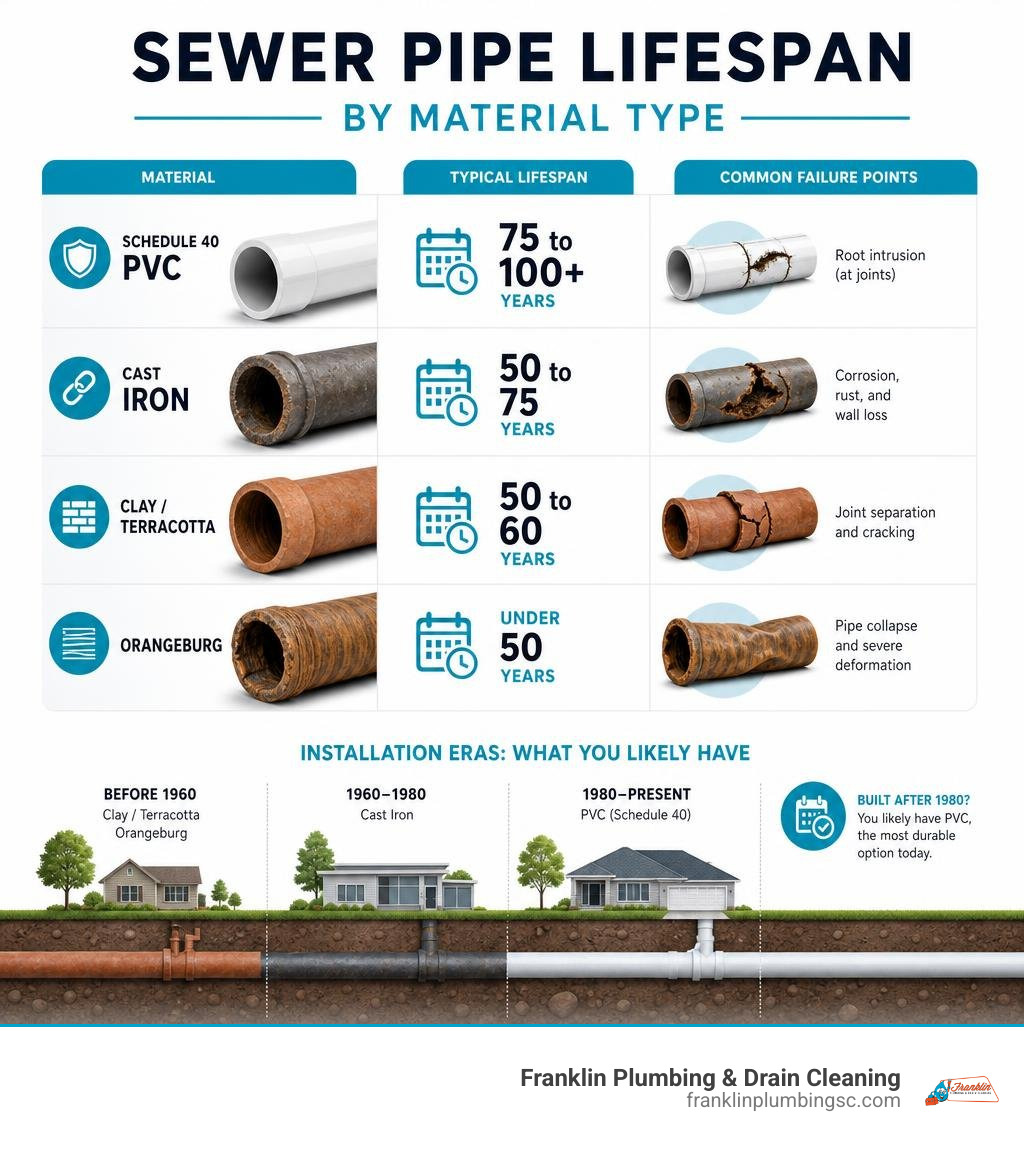
If your home was built before 1980, there’s a good chance your sewer line is made from clay or cast iron. Both materials are near or past the end of their expected service life. If your home was built after 1980, you likely have PVC, which is the most durable option on the market today.
The material matters. But so does your soil, your trees, how the pipe was installed, and how well it’s been maintained. We’ll walk through all of it below.
How Long Does Sewer Line Last by Material?
When we think about home maintenance, we often focus on the things we can see: roofs, siding, and landscaping. Underground sewer lines are easily forgotten until a major backup forces them to the top of our priority list.
To truly understand how long your home’s waste disposal system will hold up, we have to look closely at the physical properties of the pipes buried beneath your yard. Different decades brought different plumbing trends, meaning the age of your home is a major clue to what is happening underground.
For instance, if you live in our local area, municipal guidelines like the Water & Sewer – City of West Columbia | SC department regulations outline where your private responsibility ends and the city utility system begins. This division makes it even more critical to understand the durability of your specific line, as homeowners are responsible for maintaining and replacing the lateral pipe connecting the house to the main street sewer.
The table below outlines how these materials compare in terms of their overall longevity and the typical issues that bring them down:
| Sewer Pipe Material | Expected Service Life | Primary Failure Points and Weaknesses |
|---|---|---|
| Vitrified Clay | 50 to 60 years | High brittleness, joint separation, susceptibility to tree roots |
| Cast Iron | 50 to 75 years | Internal rust scaling, bottom channeling, chemical corrosion |
| Schedule 40 PVC | 75 to 100+ years | Vulnerable to improper joint gluing or heavy physical impact |
| Orangeburg | 30 to 50 years | Water absorption, structural flattening, complete collapse |
Clay and Terracotta Sewer Pipes
Vitrified clay is one of the oldest sewer materials in existence. In fact, clay pipes have been found intact in ancient archaeological sites, proving that the raw material itself is incredibly durable. It resists chemical corrosion and does not rust, which is why it was the standard choice for residential sewer lines in older neighborhoods built before 1980.
However, clay has a major flaw: it is highly brittle. While the clay itself does not degrade, the pipes are prone to cracking under ground pressure. Additionally, clay sewer lines were historically installed in short, three-foot sections. These sections were sealed together at the joints using mortar or early rubber gaskets.
Over the decades, these joints degrade and separate. Once a joint loosens, it creates an open invitation for tree roots to enter the pipe. As roots expand, they crack the brittle clay, causing structural failure and severe blockages. While clay can technically last 50 to 60 years in ideal conditions, most clay lines in older properties are already past their prime and highly susceptible to failure.
Cast Iron Sewer Pipes
Cast iron was the premium choice for residential waste lines from the early 1900s through the late 1970s. It is incredibly strong, heavy, and capable of withstand significant physical pressure from the earth above it.
Despite its strength, cast iron has a natural enemy: water. Over decades of constant exposure to moisture and household wastewater, cast iron pipes suffer from internal corrosion. This process, known as tuberculation, causes rust and mineral scale to build up along the inner walls of the pipe.
This internal scaling creates a rough, jagged surface that snags toilet paper, hair, and grease, leading to frequent and stubborn clogs. Over time, the acidic nature of wastewater can also corrode the very bottom of the pipe, creating a channel or complete void where water washes away the supporting soil underneath. While cast iron is rated to last 50 to 75 years, internal rusting often causes these pipes to fail much earlier.
Schedule 40 PVC and ABS Pipes
Beginning in the 1980s, the plumbing industry shifted toward plastic polymers like polyvinyl chloride (PVC) and acrylonitrile butadiene styrene (ABS). Today, Schedule 40 PVC is the gold standard for residential sewer lines.
Schedule 40 PVC is lightweight, completely impervious to rust and chemical corrosion, and slightly flexible, which allows it to handle minor soil shifting without cracking. It is also incredibly smooth on the inside, which prevents debris from sticking and virtually eliminates the scale buildup common in cast iron.
When it comes to longevity, PVC is unmatched. A properly installed Schedule 40 PVC sewer line is expected to last a minimum of 75 years, and it can easily surpass 100 years with routine care. Furthermore, because PVC sections are chemically welded together using a strong solvent cement, the joints are virtually seamless, offering superior resistance against invasive tree roots. To keep these modern lines running perfectly for a century, homeowners can follow essential sewer line maintenance tips to avoid unnecessary clogs.
Orangeburg Sewer Pipes
If your home was built between the 1940s and the 1970s, there is a small chance you have a material known as Orangeburg pipe. Made from compressed wood pulp bound together with coal tar, Orangeburg was popularized as a cheap, lightweight alternative to cast iron during metal shortages.
Plumbers often refer to Orangeburg as “tar paper pipe,” and its performance matches that description. It was never designed for long-term durability. Over time, the wood pulp absorbs moisture, causing the pipe to soften, lose its circular shape, and flatten under the weight of the soil.
In almost all cases, Orangeburg pipes fail in less than 50 years. Because they are essentially made of paper and tar, they cannot be cleared with mechanical drain snakes or hydro-jetting without completely destroying the pipe walls. If you have Orangeburg pipes under your property, they are likely already failing and require immediate, complete replacement.
Key Factors That Affect Sewer Line Longevity
While pipe material sets the baseline for how long a sewer line will last, the environment surrounding those pipes plays an equally massive role. Two identical PVC pipes installed in different yards can have vastly different lifespans depending on external forces.
Understanding these environmental factors can help you protect your investment and catch potential issues before they lead to structural failure. In our region, local soil characteristics are a major factor, and learning about the effects of South Carolina soil on your sewer lines can give you valuable insight into how your yard impacts your plumbing.
How Long Does Sewer Line Last Under Tree Root Pressure?
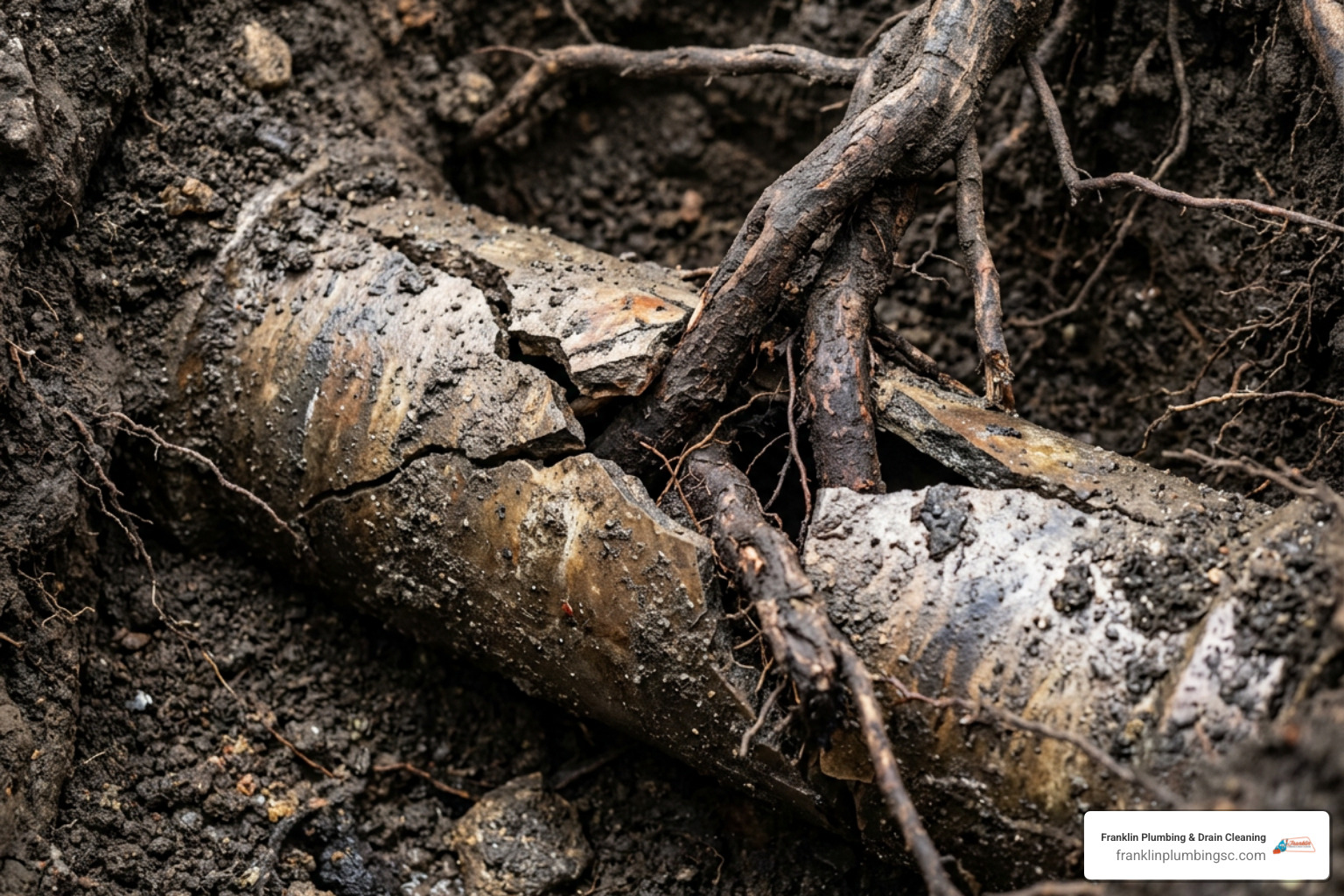
Tree roots are the single most common cause of premature sewer line failure. Trees have incredibly smart, expansive root systems designed to seek out moisture and nutrients in the soil. To a tree, a buried sewer pipe carrying warm, nutrient-rich wastewater is the ultimate target.
If your sewer line is made of clay or cast iron, tiny hairline cracks or slightly separated joints are all a root needs to gain entry. Once a single microscopic root tip finds its way inside, it begins to feed on the wastewater, growing rapidly into a dense, woody mass. This root intrusion quickly blocks the flow of waste, leading to backups.
Over time, the growing roots act like a slow-motion wedge, splitting clay pipes apart or bursting through weakened cast iron joints. Understanding how pipe clogging and blockages lead to damage is crucial, as chronic root blockages put constant physical stress on the pipe structure, drastically shortening its overall lifespan.
Soil Chemistry and Ground Movement
The soil surrounding your sewer line is far from static. In many areas, clay-heavy soils are highly expansive. This means they swell significantly when wet and shrink when dry. This constant cycle of expansion and contraction causes the ground to shift, putting immense physical stress on buried pipes.
If you have rigid pipes like clay or cast iron, this shifting soil can cause the joints to offset or snap entirely. Shifting ground can also lead to “bellies” in the line. A pipe belly is a sunken section of the pipe where wastewater pools instead of draining continuously via gravity.
Furthermore, soil chemistry can affect metal pipes. Highly acidic soil or soil with high moisture content accelerates the external corrosion of cast iron, eating away at the pipe from both the inside and the outside simultaneously.
Installation Quality and Pipe Pitch
The longevity of a sewer line is set the very day it is buried. Even the most durable Schedule 40 PVC pipe can fail prematurely if it is installed poorly.
First, a sewer line relies entirely on gravity to transport waste from your home to the municipal main. This requires a precise pitch: typically a drop of one-quarter inch per linear foot of pipe. If the slope is too steep, water rushes ahead, leaving solid waste behind to cause clogs. If the slope is too shallow, waste pools and settles, leading to chronic blockages.
Second, proper pipe support is critical. When trenches are dug, the pipes must be laid on a stable bed of compacted gravel. This gravel bedding supports the pipe evenly and prevents it from settling or sagging as the soil shifts. Without proper gravel support, the weight of the backfilled dirt can bow the pipe, creating bellies or snapping mechanical connections.
Signs Your Sewer Line is Failing or Needs Replacement
Because sewer lines are buried deep underground, homeowners rarely get a direct look at their condition. Instead, we have to rely on secondary warning signs to tell us when something is wrong.
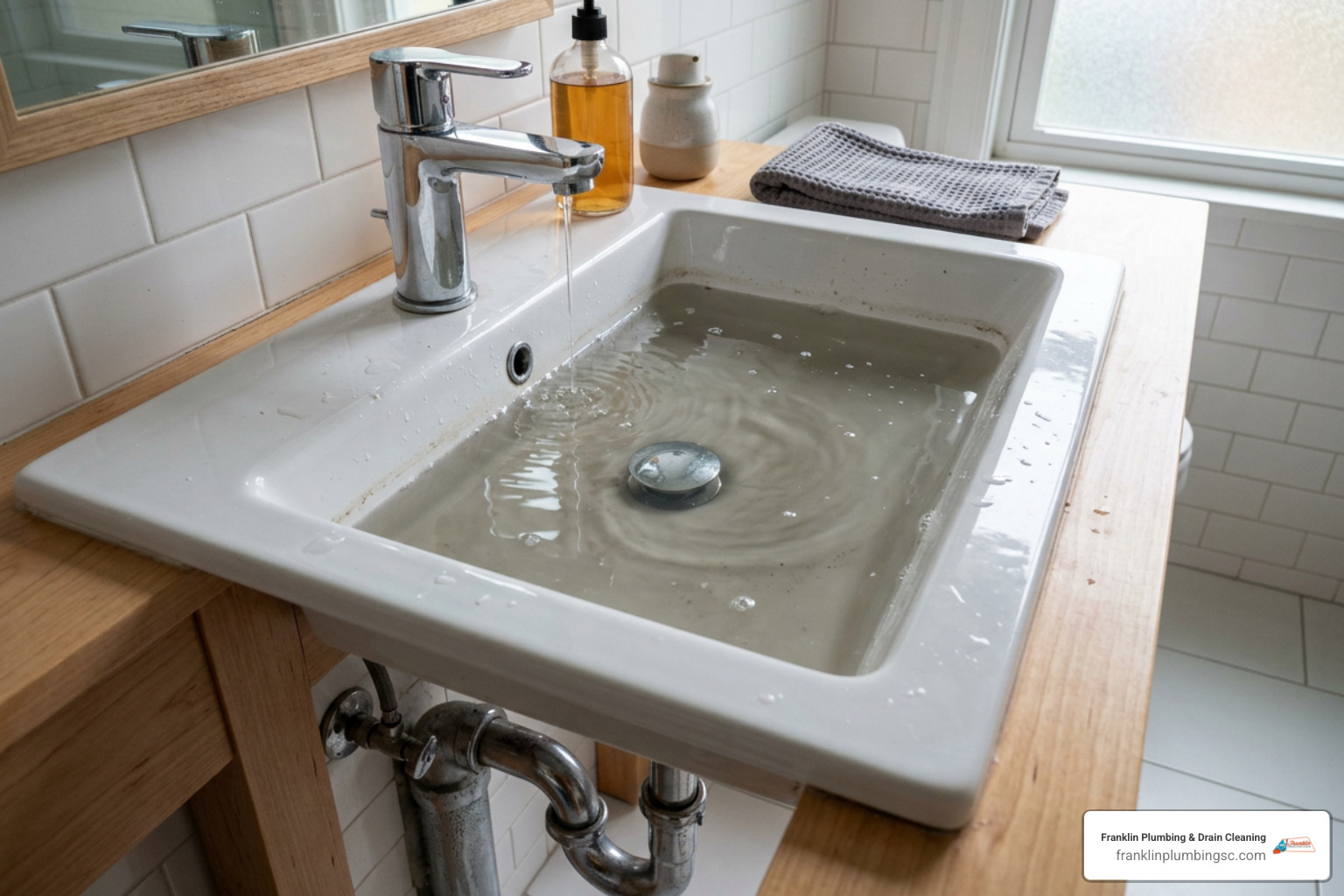
Ignoring these warnings can turn a simple repair into a highly stressful, expensive emergency. Keeping an eye out for the common signs of compromised sewer lines can help you take action before wastewater backs up into your living spaces.
Slow Drains and Frequent Clogs
A single clogged sink or toilet is usually a localized issue that can be cleared with a plunger or a simple drain snake. However, if you notice that multiple drains throughout your home are running slowly at the same time, the issue is likely deep within your main sewer line.
Pay close attention to the lowest drains in your home, such as basement showers, floor drains, or downstairs toilets. If you run your washing machine and water starts gurgling up into your bathtub, or if flushing a toilet causes water to rise in a nearby sink, your main sewer line is experiencing a severe restriction. Frequent backups that require professional clearing every few months are a clear indicator that the pipe is structurally compromised, collapsed, or heavily invaded by roots.
Sewer Gas Odors and Wet Yard Patches
A fully functional sewer system is completely sealed, keeping sewer gases directed out of your roof vents. If you begin to smell a distinct, foul odor of sewage or rotten eggs inside your home, in your basement, or out in your yard, you likely have a crack or break in your line.
Additionally, leaking sewage acts as an incredibly potent fertilizer. If you notice a specific patch of grass in your yard that is suddenly much greener, taller, and more lush than the surrounding lawn, it is a strong sign that wastewater is escaping the pipe and feeding the grass from below. In severe cases, this leaking water will saturate the soil, creating soggy, sunken patches in your lawn or even leading to localized sinkholes.
Traditional Replacement vs. Trenchless Sewer Repair
If an inspection reveals that your sewer line is failing, you generally have two main paths forward: traditional excavation or modern trenchless repair.
When planning these projects, local guidelines can help you understand what is permitted. For example, looking at the Residential Water and Sewer | Cayce, SC – Time for Life utility resources can help you coordinate with local municipal systems and ensure your chosen method complies with community standards.
How Long Does Sewer Line Last After Trenchless Relining?
Trenchless sewer repair has revolutionized the plumbing industry by allowing technicians to restore damaged pipes without digging up entire yards, driveways, or patios. The most common trenchless method is Cured-In-Place Pipe (CIPP) lining, often paired with epoxy coatings.
During a CIPP lining project, a flexible, resin-saturated sleeve is inserted into the existing damaged pipe through a single small access point. Once in place, the sleeve is inflated, pressing the resin against the inner walls of the old pipe. The resin is then cured using hot water, steam, or UV light, hardening into a smooth, seamless, and incredibly durable “pipe within a pipe.”
But how long does this fix actually last? Properly installed CIPP lining is engineered to last between 30 and 50+ years. Because the finished liner is completely jointless, it offers incredible resistance to future root intrusion and structural shifting. Reviewing the homeowner’s sewer line maintenance guide can help you implement smart habits to maximize the lifespan of a newly lined pipe.
Traditional Excavation and Replacement
While trenchless lining is an incredible option, it is not always possible. If a sewer line has completely collapsed, lost its structural shape, or suffered from severe sags and bellies, a new lining cannot fix the underlying issue. In these cases, traditional excavation is necessary.
Traditional replacement involves using heavy machinery to dig a trench along the entire path of the sewer line. The old, damaged pipe is physically removed, and a brand-new Schedule 40 PVC line is installed in its place.
While this process is highly disruptive to your landscaping and requires significant surface restoration, it has a major advantage: it allows technicians to completely correct any issues with pipe pitch or soil settling. Once complete, a traditionally replaced PVC line is essentially a permanent, century-long solution for your home.
Deciding Between Sewer Repair, Relining, and Replacement
Facing a sewer line issue can feel overwhelming, but making an informed decision comes down to evaluating three main factors: the age of the pipe, the extent of the damage, and the overall long-term value.
To help you navigate this choice, we have put together a comprehensive guide on how to know when to replace your sewer line to ensure you invest in the most reliable fix.
When to Choose Sewer Line Repair
Sewer line repair is the best choice when the damage is highly localized and the rest of the pipe is in good structural condition.
For example, if a high-quality PVC or cast iron line has a single crack caused by a stray tree root, but the rest of the pipe is clear, smooth, and structurally sound, a localized spot repair is highly cost-effective. Technicians can dig a small, targeted hole to replace just the damaged section, or apply a localized trenchless patch, saving you thousands of dollars while fully restoring the integrity of your line.
When Full Replacement is Necessary
Full replacement becomes the only logical choice when your sewer line suffers from systemic, widespread failure.
If your home still relies on Orangeburg pipes, or if you have a clay or cast iron system that is over 50 years old and riddled with multiple cracks, severe root intrusion, and major bellies, attempting to patch individual sections is simply throwing money away. In these scenarios, the surrounding pipe is already structurally compromised and will likely fail in another location shortly after. Investing in a full replacement with modern Schedule 40 PVC or a complete trenchless relining provides the peace of mind that comes with a permanent, decades-long solution.
Frequently Asked Questions
How long does a typical residential sewer line last?
On average, a residential sewer line lasts between 50 and 100 years. The actual lifespan depends heavily on the pipe material, with older clay and cast iron lines lasting 50 to 75 years, while modern Schedule 40 PVC lines can easily last 75 to over 100 years.
What is the longest-lasting sewer pipe material?
Schedule 40 PVC is the longest-lasting sewer pipe material available today. It is completely immune to rust, resists chemical corrosion, handles minor soil movement, and features seamless joints that prevent tree root intrusion, allowing it to last over a century.
How do I know what material my sewer line is made of?
The easiest and most accurate way to determine your pipe material is to schedule a professional sewer camera inspection. A plumber will run a high-definition camera through your line to visually identify the material, age, and condition of the pipe.
Can tree roots completely destroy a sewer line?
Yes, tree roots can completely destroy a sewer line. They enter through small cracks or loose joints, expand as they feed on wastewater, and can eventually split clay pipes apart, collapse cast iron lines, or cause massive, unresolvable blockages.
Is trenchless pipe lining as durable as brand-new PVC?
Yes, high-quality CIPP (Cured-In-Place Pipe) trenchless lining is highly durable and performs on par with brand-new PVC. It creates a seamless, jointless inner pipe that resists roots and corrosion, carrying an expected service life of 30 to 50+ years.
How much does it cost to replace a sewer line in Columbia, SC?
The cost of sewer line replacement can vary significantly depending on several factors, including the length of the line, the depth of the pipe, the chosen method (traditional vs. trenchless), and whether driveways or landscaping must be removed. Homeowners should request a professional estimate for accurate pricing.
Does homeowners insurance cover sewer line replacement?
Standard homeowners insurance policies typically do not cover sewer line replacement if the damage is caused by gradual wear and tear, aging, or root intrusion. However, coverage may apply if the damage is sudden and accidental, or if you have a specific service line rider added to your policy.
How often should I have my sewer line inspected?
It is highly recommended to have your sewer line inspected with a video camera every 3 to 5 years as preventative maintenance. You should also schedule an inspection immediately if you experience recurring slow drains, gurgling noises, or before buying an older home.
Can a broken sewer line cause foundation damage?
Yes, a leaking or broken sewer line can wash away the supporting soil beneath your home, leading to foundation settling, cracking, and severe structural damage over time.
Why do clay and cast iron pipes fail earlier than expected?
Clay pipes often fail early due to their natural brittleness and separated joints that invite destructive tree roots. Cast iron pipes fail prematurely due to internal rust scaling, bottom channeling, and chemical corrosion from household wastewater.
Conclusion
Your home’s sewer line is a critical piece of infrastructure that keeps your household running safely and cleanly every single day. Understanding the age, material, and warning signs of your underground pipes is the best way to prevent stressful and costly plumbing emergencies. Whether your home is built on historic clay, classic cast iron, or modern PVC, staying proactive with professional inspections and timely repairs will ensure your system lasts for decades to come.
Whether you need a routine camera inspection, targeted spot repairs, or a complete system replacement, our team is ready to help. Franklin Plumbing & Drain Cleaning provides experienced, licensed technicians and a 100% satisfaction guarantee to keep your home’s plumbing in perfect working order. Schedule professional sewer repair in Columbia, SC with our friendly team today to secure your peace of mind.

professional
drain cleaning

highly
recommended

through
repairs

quality
work