How to Shut Off Your Water Main: A 60-Second Guide
Home »

What to Do When You Need to Shut Off Your Water Main Right Now
Knowing how to shut off your water main can be the difference between a minor inconvenience and costly damage.
Here’s the quick answer:
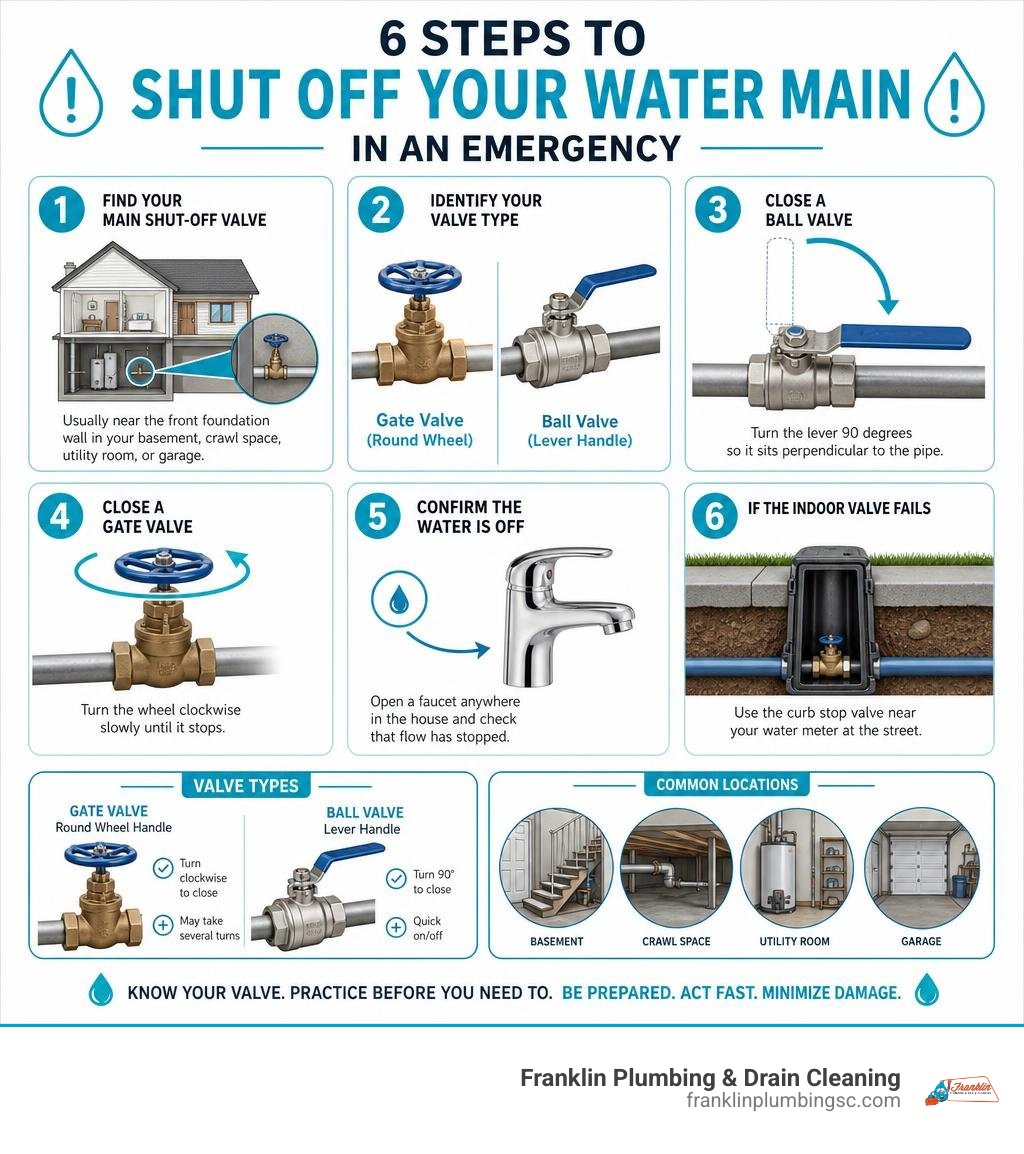
- Find your main shut-off valve: usually near the front foundation wall in your basement, crawl space, utility room, or garage.
- Identify your valve type: a round wheel handle means a gate valve; a lever handle means a ball valve.
- Close a ball valve: turn the lever 90 degrees so it sits perpendicular to the pipe.
- Close a gate valve: turn the wheel clockwise slowly until it stops.
- Confirm the water is off: open a faucet anywhere in the house and check that flow has stopped.
- If the indoor valve fails: use the curb stop valve near your water meter at the street.
That’s the core of it. Now let’s walk through each step in detail so you’re ready before an emergency hits.
Most homeowners only think about their main shut-off valve while standing in inches of water at 2 a.m. By then, it’s already too late to avoid real damage. A single flooded room can become an expensive restoration project, depending on how fast you catch it.
The good news? Shutting off your water main takes under 60 seconds once you know where to look and what to do. This guide covers everything: finding the valve, operating it safely, maintaining it, and using the street-side backup when your indoor valve fails.
Why You Need to Know How to Shut Off Your Water Supply
When a plumbing disaster strikes, every second counts. A ruptured supply line or a failed appliance can dump dozens of gallons of water into your home in a matter of minutes. If you do not know how to shut off the water main quickly, a minor leak can rapidly escalate into structural damage.
Water damage spreads fast, soaking through drywall, ruining hardwood floors, and destroying carpets. Beyond the immediate structural issues, standing water creates a perfect breeding ground for mold and mildew within 24 to 48 hours. Knowing how to locate and operate your main valve is your first line of defense against these costly repairs.
While major pipe bursts are obvious emergencies, smaller issues also require you to shut off the main water supply. For instance, if you notice signs of a hidden water leak, such as unexplained spikes in your utility bill, soft spots on your floors, or a musty odor near your walls, you may need to close the main valve to isolate the system while waiting for professional help.
Additionally, winter weather in areas like Columbia, SC and Lexington, SC can bring unexpected freezing temperatures. Taking proactive steps, including preparing your plumbing for winter, can protect your pipes from freezing and bursting. If a pipe does freeze and rupture, shutting down the water main immediately is the only way to halt the flooding once the ice thaws.
Locating Your Main Water Shut-Off Valve
Finding your main water valve before an emergency occurs is one of the smartest things you can do as a homeowner. In most residential properties, the main shut-off valve is located inside the house, near the point where the municipal water line enters the foundation.
Depending on the design of your home, look in these common areas:
- Basements and Crawl Spaces: The valve is typically located on the front foundation wall, usually within a few feet of where the water line enters the house. It is often positioned close to your water meter.
- Utility Rooms or Garages: If your home does not have a basement, check your utility closet, water heater room, or garage. The valve is often installed near the water heater or along the wall closest to the street.
- Slab Foundations: For homes built on a concrete slab, the main valve is frequently located inside a utility closet, laundry room, or under the kitchen sink near the front of the property.
If you struggle to locate the valve, check your home inspection report from when you purchased the property. These reports almost always document the exact location of the main water shut-off valve with photographs.
Once you find your valve, we highly recommend labeling it with a bright, waterproof tag. This ensures that anyone in your household can locate it quickly during a stressful emergency.
How to Shut Off Water Main Valves: Step-by-Step
Once you have located the valve, you must identify what type of valve you have. Operating the valve incorrectly can damage your pipes or even snap the valve stem, turning a stressful situation into a full-scale plumbing emergency.
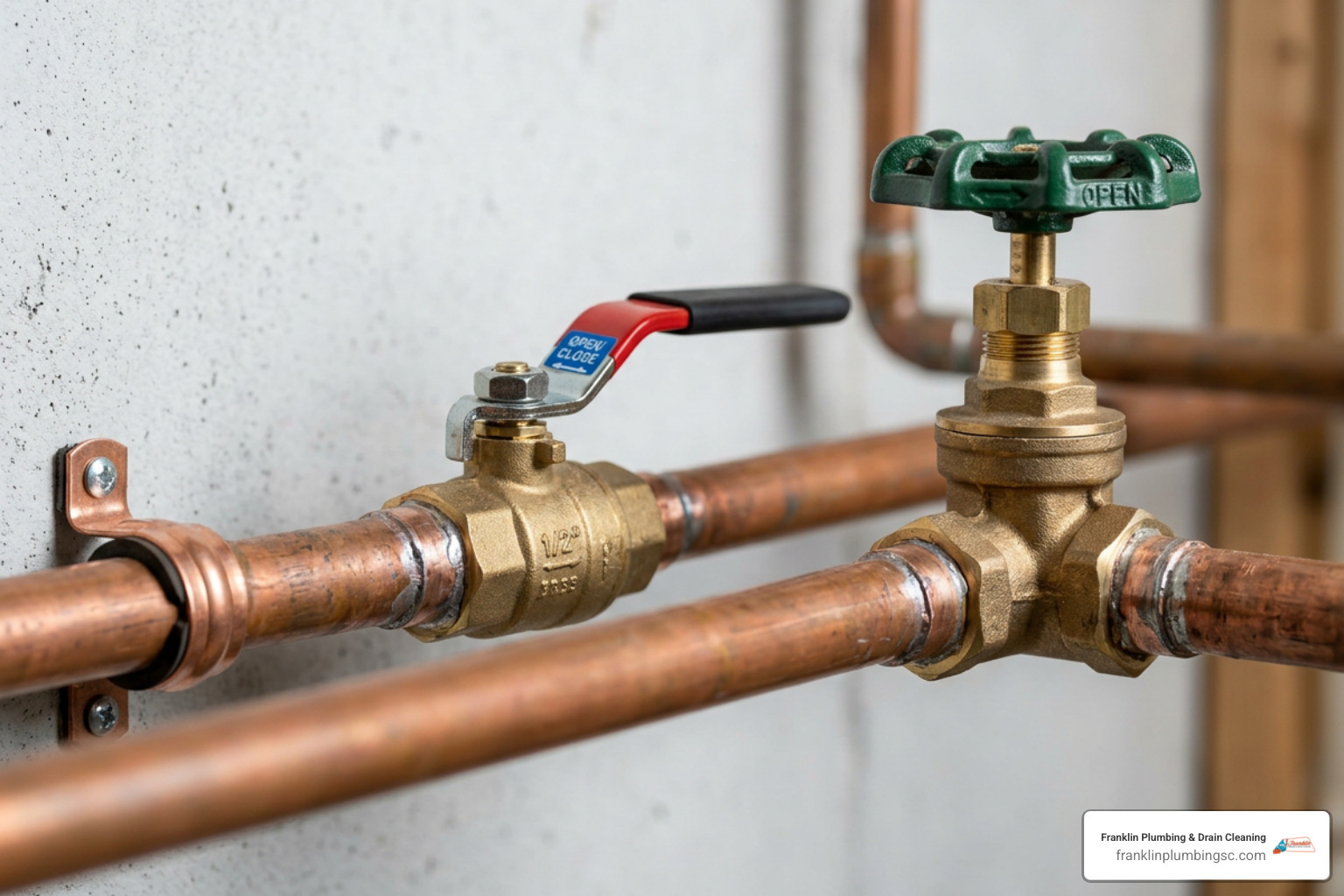
When closing your water main, always turn the handle slowly and steadily. Turning any water valve too quickly can cause a sudden spike in pressure known as water hammer. This pressure shockwave can weaken pipe joints or damage older fixtures downstream.
To help you understand the differences between the two primary valve types, we have compiled a quick comparison table below:
| Feature | Ball Valve | Gate Valve |
|---|---|---|
| Handle Type | Straight lever handle | Round wheel handle |
| Operation | Quarter-turn, 90 degrees | Multiple clockwise rotations |
| Reliability | Highly reliable and rarely seizes | Prone to corrosion and seizing |
| Emergency Speed | Fast and closes in one second | Slower and takes several seconds to turn |
| Visual Status | Perpendicular is off; parallel is on | Requires checking hand tightness |
How to Shut Off Water Main Ball Valves
Modern homes are typically equipped with ball valves. These valves feature a straight lever handle that controls a polished metal sphere inside the pipe.
To shut off a ball valve:
- Locate the straight lever handle.
- Turn the handle 90 degrees so that it sits perpendicular to the water pipe.
- When the handle is aligned with the pipe, the water is fully on. When it forms a “T” shape with the pipe, the water is completely shut off.
Ball valves are highly favored by plumbers because they are durable and rarely seize up over time. Understanding how these reliable valves work is a great way to avoid common habits that damage your plumbing and ensure your home remains safer from water emergencies.
How to Shut Off Water Main Gate Valves
Older homes often feature gate valves, which use a round wheel handle similar to an outdoor garden spigot. Inside the valve, a metal gate lowers to block the flow of water as you turn the wheel.
To shut off a gate valve:
- Grip the round wheel handle firmly.
- Turn the wheel clockwise, or to the right, to close the valve. Remember the old phrase: “righty-tighty, lefty-loosey.”
- Continue turning the wheel until it stops. Do not force or over-tighten the handle once it resists, as older metal parts can become brittle.
Because gate valves are prone to mineral buildup and corrosion, they can be difficult to turn if they have not been touched in years. Forcing a stuck gate valve can break the internal mechanism, leaving the valve permanently open or closed. Learning to handle these delicate fixtures is part of a list of simple things to stop doing to protect your plumbing and prevent accidental pipe damage.
Testing, Maintenance, and Troubleshooting Your Shut-Off Valve
Your main water shut-off valve is not a “set it and forget it” device. Because these valves sit idle for months or years at a time, minerals in our municipal water can cause them to corrode and seize up.
To prevent your valve from failing when you need it most, perform an annual test:
- Locate your valve and slowly turn it to the fully closed position.
- Go to a faucet on the lowest level of your home and turn on the water.
- If the water stops flowing completely after a few seconds, your valve is working properly.
- Slowly reopen the main valve to restore flow, then check around the valve stem for any signs of dripping or weeping.
If you find that your valve is stuck or leaking around the handle, do not panic. Apply a small amount of penetrating oil to the valve stem and let it sit for 15 to 20 minutes before trying to turn it gently with a wrench. If it still refuses to budge, call a licensed plumber to replace it. Attempting to force a corroded valve can snap the metal stem, causing an immediate flood.
Before you begin any testing or maintenance that requires shutting off your water supply, make sure you take steps for maintaining your water heater. If you turn off your main water supply, you should always shut off the power breaker to an electric water heater or turn a gas water heater to “pilot” or “vacation” mode. Heating elements can quickly burn out if they operate without a steady supply of water.
When a shut-off problem involves a broken main line, recurring leaks, or a valve that will not close, it is safest to bring in a professional team for water line repair services. This keeps the repair focused on the full plumbing system rather than a temporary fix at one fixture.
Having an emergency plumbing kit on hand is also highly recommended. Keep these essential tools stored near your main valve:
- A high-quality flashlight or headlamp
- An adjustable wrench or slip-joint pliers
- Penetrating oil
- Clean rags to wipe up minor drips
- A dedicated water meter key, also called a curb key
Using the Curb Stop Valve at the Street as a Backup
If your indoor main shut-off valve is seized, leaking, or completely broken during an emergency, you still have a backup option: the curb stop valve.
The curb stop is a master shut-off valve located outside your property line, typically near the street or sidewalk. It is housed inside a round concrete or plastic box with a heavy metal lid, often labeled “WATER” or “METER.”
To access and operate the curb stop valve:
- Locate the meter box near your front property line. Use a screwdriver to pry open the heavy metal lid. Be careful, as these boxes can sometimes harbor spiders, frogs, or dirt.
- Locate the valve inside the box. It is usually positioned on the street-side of your water meter.
- Use a T-shaped water meter key from a hardware store to reach down and grip the valve’s operating nut.
- Turn the key 90 degrees until the two metal loops on the valve align. When these holes are perfectly aligned, the valve is completely closed.
The curb stop valve and water meter are technically the property of your municipal utility provider. Under normal circumstances, homeowners should not tamper with this valve. However, during a major flooding emergency where your indoor valve has failed, using the street valve to protect your property is widely accepted. Once the emergency is resolved, contact your local utility provider or a professional plumbing team to handle any permanent repairs.
If the emergency started with a clogged or backed-up drain, schedule professional drain cleaning services after the water is safely shut off. Clearing the underlying blockage helps reduce the chance of another overflow once the system is back in use.
Frequently Asked Questions about Water Shut-Off Valves
Where is the main water shut-off valve located in a house on a slab?
For homes built on a slab foundation, the valve is typically located inside a utility closet, a laundry room, or directly under the kitchen sink near the front of the house. Look for the main cold water pipe entering the wall or floor.
What is the difference between a gate valve and a ball valve?
A gate valve features a round wheel handle and uses an internal gate that lowers or raises over multiple turns. A ball valve features a straight lever handle and uses a rotating sphere to shut off water with a simple quarter-turn.
Can shutting off the main water supply damage my water heater?
Yes, if the heating elements continue to run without water. Before closing your main valve, turn off the electrical breaker to your water heater or set your gas water heater to “pilot” or “vacation” mode to prevent the tank from overheating or burning out its elements.
What should I do if my main water shut-off valve is stuck?
Do not force it. Apply a small amount of penetrating oil to the valve stem and let it sit for several minutes. If it remains stuck, call a licensed plumber to replace the valve with a modern ball valve.
How often should I test my main water shut-off valve?
You should test your valve at least once a year. Exercising the valve annually keeps the internal parts moving and prevents mineral deposits from seizing the mechanism.
Is it legal to shut off the water at the street curb stop?
While the curb stop is municipal property, utility companies understand that homeowners may need to turn it off during a severe emergency to prevent property damage. For routine plumbing repairs, always use your indoor valve.
Why is my faucet sputtering after turning the water back on?
Sputtering is caused by trapped air inside your plumbing lines. To resolve this, open your faucets slowly starting from the highest floor of your home and let the water run until it flows smoothly.
Should I shut off the water main when going on vacation?
Yes. Turning off your main water supply before leaving for an extended trip provides great peace of mind. If a pipe or appliance hose fails while you are away, the damage will be minimal.
What tools do I need for an emergency water shut-off?
You should keep a flashlight, an adjustable wrench, pliers, penetrating oil, and a T-shaped water meter key readily available in your home.
Who is responsible for repairing a broken main water shut-off valve?
The homeowner is responsible for repairing or replacing the main shut-off valve located inside the home. The municipal utility provider is responsible for maintaining the water meter and the curb stop valve at the street.
Conclusion
Being prepared for a plumbing emergency is one of the most important aspects of homeownership. Knowing how to shut off your water main in under 60 seconds can protect your property, save your belongings, and prevent costly water damage repairs.
While manual testing and basic maintenance can keep your system in good shape, older valves will eventually need to be upgraded. If you discover that your main shut-off valve is corroded, leaking, or completely seized, do not attempt to force it yourself. Professional tools and experience are required to replace these vital components safely.
Whether you live in Columbia, SC, West Columbia, SC, Lexington, SC, or Irmo, SC, our team of licensed technicians is here to help with all your plumbing needs. From installing modern, reliable ball valves to handling emergency pipe repairs, we offer top-tier service backed by a 100% satisfaction guarantee.
If you are dealing with a stuck valve, a hidden leak, or simply want to upgrade your home’s emergency preparedness, the experienced team at Franklin Plumbing & Drain Cleaning is ready to assist. Contact our professional water line technicians to ensure your home is fully protected.

professional
drain cleaning

highly
recommended

through
repairs

quality
work