
What Size Water Heater Do You Need? A Sizing Guide
Home »

What Size Water Heater Do You Actually Need?
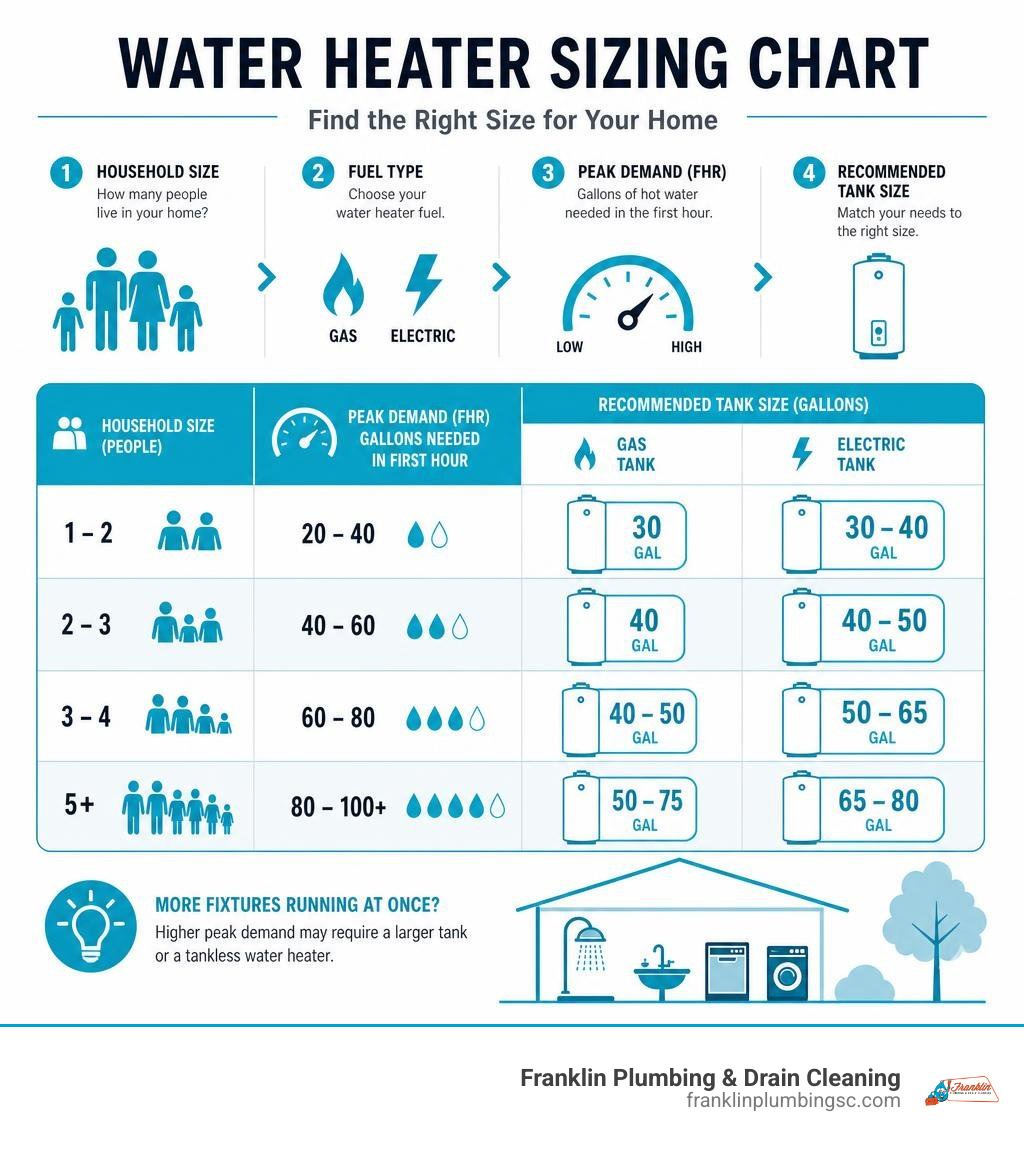
What size water heater do I need is one of the most common questions homeowners face when their old unit starts failing. The short answer depends on your household size, fuel type, and peak hot water demand. Here’s a quick reference to get you started:
| Household Size | Gas Tank | Electric Tank |
|---|---|---|
| 1-2 people | 30 gal | 30-40 gal |
| 2-3 people | 40 gal | 40-50 gal |
| 3-4 people | 40-50 gal | 50-65 gal |
| 5+ people | 50-75 gal | 65-80 gal |
Note: These are starting points. Your actual needs depend on usage habits, climate, and how many fixtures run at the same time.
But here’s the thing most people get wrong: tank size alone doesn’t tell the whole story.
A 40-gallon gas tank can deliver around 70 gallons in the first hour because the burner keeps heating water as you draw it. A 40-gallon electric tank? Only about 45 gallons. Same size, very different performance.
That gap matters a lot during a busy morning when showers, the dishwasher, and the washing machine are all running at once. A family of four during the morning rush can easily need 80 to 100 gallons of hot water in a single hour.
Pick the wrong size and you’ll either run cold halfway through your shower or waste money heating water you never use.
This guide walks you through exactly how to size a tank or tankless water heater for your home, so you can make a confident decision.
Why Sizing Your Water Heater Correctly Matters
When it comes to home appliances, bigger is not always better, and smaller is almost always a recipe for morning arguments. Choosing the correct water heater size is a balancing act that directly impacts your daily comfort, your monthly utility bills, and the overall health of your plumbing system.
If your water heater is too small, you will experience the dreaded lukewarm shower. This happens because the demand for hot water outpaces the speed at which your system can recover. Beyond the immediate discomfort of an icy blast in the middle of a shampoo, an undersized unit suffers from constant strain. It is forced to run continuously at maximum capacity, which accelerates wear and tear, shortens the system lifespan, and leads to premature breakdowns.
Conversely, installing an oversized unit is a waste of money. Traditional tank water heaters must constantly maintain the temperature of the stored water. If you install a larger tank than your household needs, you may pay to heat gallons of water that sit unused. This can result in unnecessarily high energy bills month after month.
Additionally, incorrect sizing can sometimes manifest as issues with water pressure or system cycling. If you are starting to notice these performance dips, or if your current system is simply getting old, it is vital to recognize the signs that help you decide when to replace your water heater before an emergency flood occurs in your basement or utility closet.
What Size Water Heater Do I Need? Sizing by Household Size
The most common way homeowners begin their search is by looking at general household size. While this is a helpful starting point, it is crucial to understand how fuel type alters these estimates.
Storage capacity is the physical amount of water the tank holds, but the true measure of a water heater’s capability is its recovery rate: how quickly it can heat cold water back up to the desired temperature. Because natural gas burners heat water much faster than electric resistance elements, a gas water heater can often be smaller in physical capacity than an electric unit while delivering the same amount of hot water during peak times.
When planning a replacement, you can use household size, first-hour rating, and recovery rate together rather than relying on tank capacity alone. Let us break down the standard residential recommendations:
- 1 to 2 People: A 30-gallon gas or electric tank is usually sufficient for small households with staggered schedules.
- 2 to 3 People: A 40-gallon gas tank or a 40 to 50-gallon electric tank works well for average households with moderate, everyday hot water needs.
- 3 to 4 People: A 40 to 50-gallon gas tank or a 50 to 65-gallon electric tank is ideal. This is the sweet spot for many families living in Columbia, SC.
- 5 or More People: A 50 to 75-gallon gas tank or a 65 to 80-gallon electric tank ensures that larger families do not run out of hot water during back-to-back showers.
If you are currently evaluating your options, choosing from the best types of water heaters for residential use will depend heavily on whether you have access to natural gas or rely entirely on electricity.
How Do I Calculate What Size Water Heater Do I Need Based on Peak Demand?
To move beyond generic estimates, you need to calculate your household’s peak hour demand. This represents the absolute maximum amount of hot water your family uses during their busiest one-hour window of the day. For most homes, this is the morning rush between 6:00 AM and 8:00 AM, or the evening wind-down.
To calculate this, think about all the activities that occur simultaneously or in rapid succession during your busiest hour:
- Shower or Bath: Uses approximately 10 to 25 gallons of hot water per use.
- Automatic Dishwasher: Uses about 5 to 10 gallons per cycle.
- Washing Machine: Uses 15 to 30 gallons per load if using a hot or warm water cycle.
- Shaving or Hand Washing: Uses about 1 to 3 gallons per occurrence.
Let us look at a real-world scenario. A family of four with two morning showers, two shaves, and a dishwasher cycle running simultaneously at 7:00 AM hits approximately 46 gallons of peak demand. However, if that same family has teenagers who take longer showers, or if laundry is run at the same time, the morning rush in a four-person household can easily spike to 80 to 100 gallons of peak hour demand.
By adding up the gallons for all the activities that happen during your busiest hour, you will find the minimum capacity your new water heater must be able to deliver.
Understanding First Hour Rating (FHR) vs. Tank Capacity
Once you have calculated your peak hour demand, you can ignore the physical tank size on the front of the box and focus instead on the First Hour Rating. The FHR is the true metric of a water heater’s performance. It represents the total number of gallons of hot water the unit can supply in a single hour, starting with a fully heated tank.
You can find the FHR listed on the bright yellow EnergyGuide label on any conventional storage water heater.
FHR is calculated using a combination of the storage tank capacity and the recovery rate of the heating source:
$$\text{First Hour Rating (FHR)} = \text{Tank Capacity (Gallons)} \times 0.70 + \text{Recovery Rate (Gallons per Hour)}$$
Because gas burners have a much higher heating capacity than electric elements, their recovery rates are vastly superior:
- Gas Burners: Typically recover at a rate of 35 to 50 gallons per hour. This is why a standard 40-gallon gas tank has an FHR of around 70 gallons.
- Electric Elements: Typically recover at a rate of 20 to 25 gallons per hour. Consequently, a 40-gallon electric tank has an FHR of only about 45 gallons.
When shopping for a new system, always choose a water heater with an FHR that is within 1 to 2 gallons of your calculated peak hour demand.
Sizing a Tankless Water Heater: Flow Rate and Temperature Rise
Tankless water heaters, also known as demand-type or on-demand water heaters, do not store hot water. Instead, they use high-powered burners or elements to heat cold water instantly as it flows through the unit. This design offers space savings and provides an endless supply of hot water. However, because there is no stored reserve, sizing a tankless system is completely different from sizing a tank system.
To size a tankless water heater, you must determine two key factors: the required flow rate in Gallons Per Minute (GPM) and the required temperature rise.
If you are considering making the transition to an on-demand system, reaching out for our professional tankless water heater services is the best way to ensure your gas lines and venting paths are properly prepared for the upgrade.
What Size Water Heater Do I Need When Switching to Tankless?
When switching to a tankless system, you must size the unit to handle the maximum number of fixtures that might be used at the exact same time.
Start by listing all the hot water fixtures you expect to run simultaneously, and add their average flow rates together:
- Low-Flow Showerhead: 1.5 to 2.0 GPM
- Standard Showerhead: 2.5 GPM
- Bathroom Faucet: 0.5 to 1.5 GPM
- Kitchen Faucet: 1.0 to 2.2 GPM
- Dishwasher: 1.0 to 2.0 GPM
- Washing Machine: 1.5 to 3.0 GPM
For example, if you want to be able to run two standard showers at 2.5 GPM each and the kitchen faucet at 1.5 GPM at the same time, your tankless water heater must be able to support a total flow rate of 6.5 GPM.
While tankless systems offer real convenience, they must be maintained properly to avoid performance drops. It is helpful to understand why tankless water heaters are not free from issues and damage so you can prevent scale buildup from clogging your heat exchanger and reducing your available flow rate.
Calculating Temperature Rise Based on Climate
The second half of the tankless sizing equation is temperature rise, also known as Delta T ($\Delta T$). This is the difference between the temperature of the cold water entering your home and the desired temperature of the hot water leaving your fixtures, which is typically set to 120°F.
$$\text{Temperature Rise } (\Delta T) = \text{Desired Hot Water Temp } (120^\circ\text{F}) – \text{Incoming Groundwater Temp}$$
Your incoming groundwater temperature depends entirely on your geographic location. In the Midlands of South Carolina, including areas like Columbia, SC and Lexington, SC, our average winter groundwater temperature hovers around 50°F to 55°F. To reach a comfortable 120°F, your tankless unit must be capable of producing a 65°F to 70°F temperature rise.
This temperature rise directly impacts the flow rate a tankless unit can sustain. As the incoming water gets colder, the unit must slow down the flow of water through the heat exchanger to ensure it reaches the target temperature.
To calculate the required heating capacity in British Thermal Units (BTU) per hour, use the following formula:
$$\text{Required BTU/hr} = \text{Required GPM} \times \text{Temperature Rise } (\Delta T) \times 500$$
For example, a household in Columbia, SC needing 6 GPM at a 70°F rise to run multiple fixtures in the winter would require:
$$6 \times 70 \times 500 = 210{,}000 \text{ BTU/hr}$$
This math shows why a high-capacity gas unit is often necessary to support multiple simultaneous showers in our climate during the winter months.
Comparing Fuel Types: Gas, Electric, and Heat Pump Sizing Differences
The fuel source you use has a massive impact on sizing, recovery speed, and operational costs. While natural gas has traditionally been the go-to for rapid recovery, modern heat pump technology has completely changed the landscape of energy efficiency.
No matter which fuel type you choose, keeping your system running efficiently requires regular upkeep. Following proper steps on how to maintain your water heater will ensure that your heating elements or burners continue to transfer heat efficiently to the water.
Sizing Considerations for Hybrid Heat Pump Water Heaters
Hybrid heat pump water heaters, also known as hybrid electric water heaters, are incredibly efficient. Instead of generating heat directly through electric resistance elements, they use a small compressor and refrigerant cycle to pull heat from the surrounding air and transfer it into the water tank.
In mild climates like South Carolina, heat pump water heaters can use far less energy than standard electric resistance tanks and may reduce operating costs compared with some conventional systems. This can translate to meaningful utility savings over the lifespan of the system.
However, heat pump water heaters recover much slower than standard gas or electric units when operating solely in heat pump mode. To compensate for this slower recovery, hybrid units are designed with larger storage capacities. If you are replacing a 40-gallon standard electric tank, you will generally want to size up to a 50-gallon or 65-gallon hybrid heat pump water heater to ensure you do not run out of hot water during peak hours.
Additionally, hybrid units require specific installation conditions. They need to be installed in an unconditioned space with enough surrounding air, such as a garage or large utility room, so they have warm air to draw heat from, and they require a drain path for the condensation they produce.
Sizing Constraints for Electric Tankless Systems
While gas tankless water heaters are highly versatile, electric tankless systems face severe mathematical and physical limitations in residential applications.
To heat water instantly using electricity requires an immense amount of power. A whole-house electric tankless unit capable of delivering a modest 4 to 5 GPM at a 70°F rise typically draws significant electrical capacity and may require dedicated high-amperage circuits.
For many homes in our service area, installing a whole-house electric tankless unit can require electrical upgrades, which adds complexity to the project. Because of these intense electrical demands, electric tankless systems are usually only practical for small, low-demand apartments, or as point-of-use heaters installed directly under a single remote sink.
Key Installation Factors Beyond Sizing
Finding the correct capacity is only half the battle. When choosing a new water heater, you must also account for the physical constraints of your home.
Modern water heaters are physically larger than units built a decade ago. Due to federal insulation standards, a modern 50-gallon tank can be wider and taller than an older unit. If your water heater is tucked away in a tight closet, under a staircase, or in a low-ceiling crawlspace, physical space can be a major issue.
In tight spaces, lowboy or short models are often required because they are shorter but wider to maintain capacity.
Additionally, if you are upgrading to a high-capacity gas tank or a gas tankless unit, you must ensure that your existing gas lines are large enough to supply the necessary BTUs, and that you have a proper venting path through the roof or an exterior wall. If you are planning a replacement, our team can help you think through safe placement, access, and efficiency while also considering where to place your water heater tank before installation.
If you are currently experiencing issues with your system, or if you need professional guidance on sizing and installation, our licensed technicians can help you compare repair, replacement, and water heater service options based on your home’s layout, fuel source, and daily hot water demand.
Frequently Asked Questions
Is a 40-gallon water heater enough for a family of 4?
A 40-gallon gas water heater can be sufficient for a family of four with staggered bathing schedules and water-efficient fixtures because of its rapid recovery rate. However, a 40-gallon electric water heater is typically too small for a family of four, as it recovers much slower and will likely run out of hot water during peak morning usage.
What happens if my water heater is too small?
If your water heater is too small, you will experience frequent lukewarm showers and long wait times for the water to heat back up. The system will also be subjected to constant operational stress, leading to higher energy bills, frequent component failures, and a significantly shorter system lifespan.
What is the difference between a 40-gallon and 50-gallon water heater?
The primary difference is the physical storage capacity and the First Hour Rating. A 50-gallon water heater holds ten more gallons of hot water in reserve and typically delivers a higher FHR, allowing it to support multiple simultaneous showers and appliance cycles much better than a 40-gallon model.
How do I know my incoming groundwater temperature?
Your incoming groundwater temperature is determined by your geographic location. In South Carolina, our groundwater temperatures range from about 50°F in the winter to 65°F in the summer. You can measure your exact inlet temperature by running a cold water faucet closest to your main water line for a few minutes and holding a thermometer under the stream.
Should I choose a tank or tankless water heater?
The choice depends on your budget, household usage, and space constraints. Tank water heaters have a lower upfront installation cost and handle high simultaneous demand well. Tankless water heaters have a higher upfront cost but offer substantial space savings, an endless supply of hot water, and a longer overall lifespan.
How long do residential water heaters typically last?
Traditional storage tank water heaters typically last 8 to 12 years. Tankless water heaters can last 15 to 20 years or more, provided they receive regular annual maintenance and flushing to prevent scale buildup.
What size tankless water heater do I need for a 2-bathroom home?
For a typical two-bathroom home in South Carolina, you will need a tankless water heater capable of delivering at least 5 to 6 GPM at a 70°F temperature rise. This capacity, usually provided by a high-capacity gas unit, allows you to run two showers simultaneously without losing hot water.
Why does electric tankless water heater installation cost more?
Electric tankless installations often cost more because of the electrical demands of the units. Many homes require electrical upgrades and heavy-duty wiring runs to support whole-house electric tankless performance.
What are the space requirements for a hybrid heat pump water heater?
Hybrid heat pump water heaters need enough surrounding air to operate efficiently. They also need proper height clearance for the top-mounted compressor and a nearby drain for condensate disposal.
How often should I perform maintenance on my water heater?
You should perform maintenance on your water heater at least once a year. This includes flushing the tank to remove sediment, inspecting the sacrificial anode rod for corrosion, and testing the temperature and pressure relief valve.
Conclusion
Sizing a water heater is a precise science that requires balancing your household’s peak demand, your fuel source, and your local climate. Whether you decide on a highly efficient hybrid heat pump, a space-saving gas tankless system, or a reliable traditional storage tank, getting the size right is key to long-term comfort and energy savings.
At Franklin Plumbing & Drain Cleaning, we provide professional, licensed plumbing services throughout Columbia, SC, West Columbia, SC, Lexington, SC, Irmo, SC, and the surrounding areas. Our experienced technicians back every installation with a 100% satisfaction guarantee, ensuring your new system is sized for your home’s unique needs.
If you are ready to upgrade your home’s comfort, contact our professional water heater technicians today.

professional
drain cleaning

highly
recommended

through
repairs

quality
work