Tankless vs. Tank Water Heater in Lexington, SC
Home »
The Real Difference Between Tankless and Tank Water Heaters in Lexington, SC
When it comes to tankless vs tank water heater in Lexington, most homeowners want a simple answer: which one is better for my home and my budget?
Here’s a quick breakdown before we dive deeper:
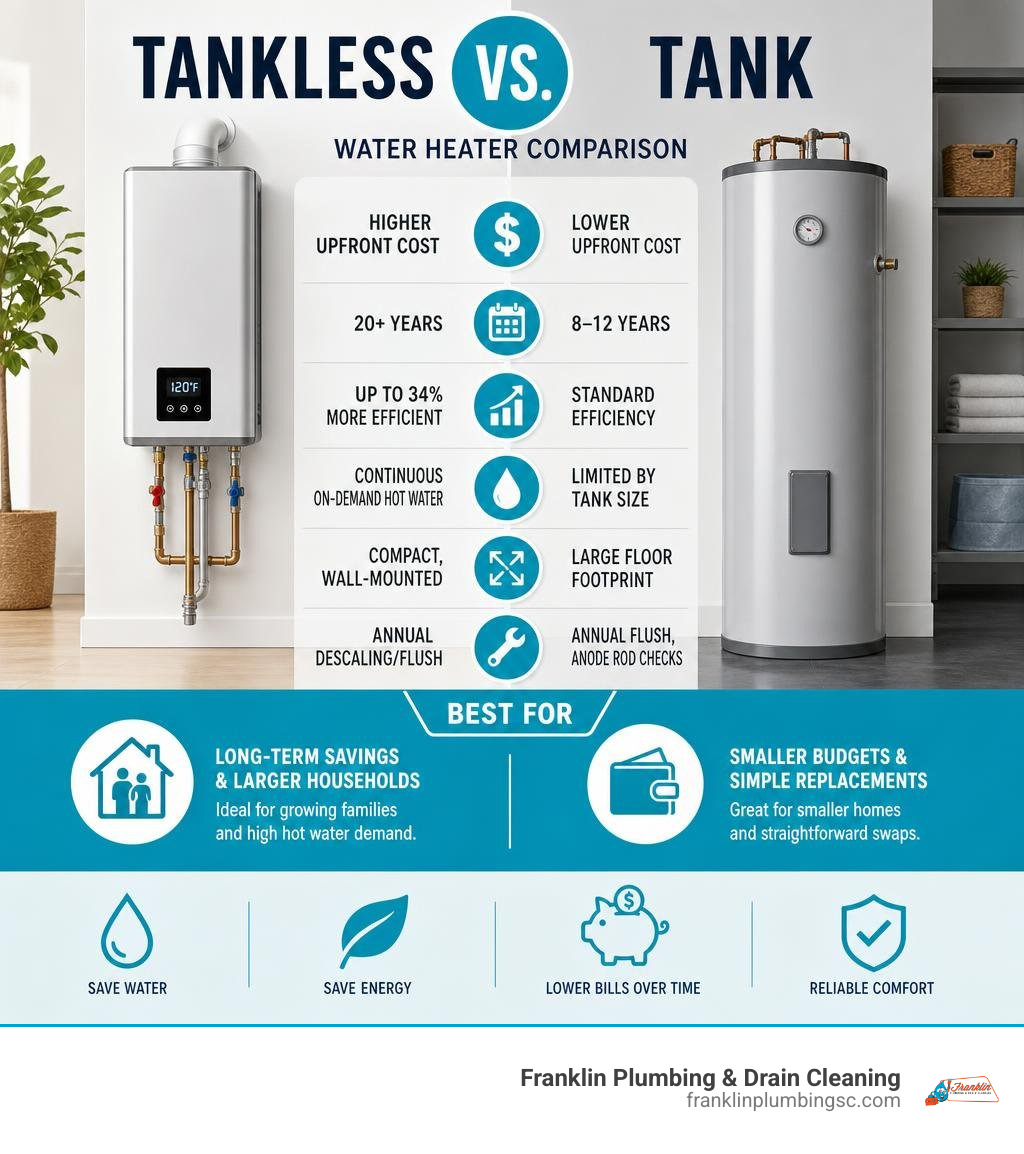
| Feature | Tank Water Heater | Tankless Water Heater |
|---|---|---|
| Upfront cost | Lower | Higher |
| Lifespan | 8-12 years | 20+ years |
| Energy efficiency | Standard | Up to 34% more efficient |
| Hot water supply | Limited by tank size | Continuous, on-demand |
| Space required | Large floor footprint | Compact, wall-mounted |
| Maintenance | Annual flush, anode rod checks | Annual descaling/flush |
| Best for | Smaller budgets, simple replacements | Long-term savings, larger households |
The short answer: tankless units cost more upfront but save money over time. Tank models are simpler and cheaper to install but wear out faster and carry higher energy bills.
You’ve probably been there before. You finish the dishes, jump in the shower, and the water goes lukewarm halfway through. That’s a classic sign of a tank heater running low. Or maybe your current unit is pushing 10 years old and you’re wondering whether to replace it like-for-like or make the switch.
Either way, the choice between these two systems is one of the biggest home maintenance decisions you’ll make. And in Lexington, SC, where water quality and seasonal temperatures both play a role, the right answer depends on your household’s specific needs.
Understanding the Core Differences: Tankless vs Tank Water Heater Lexington
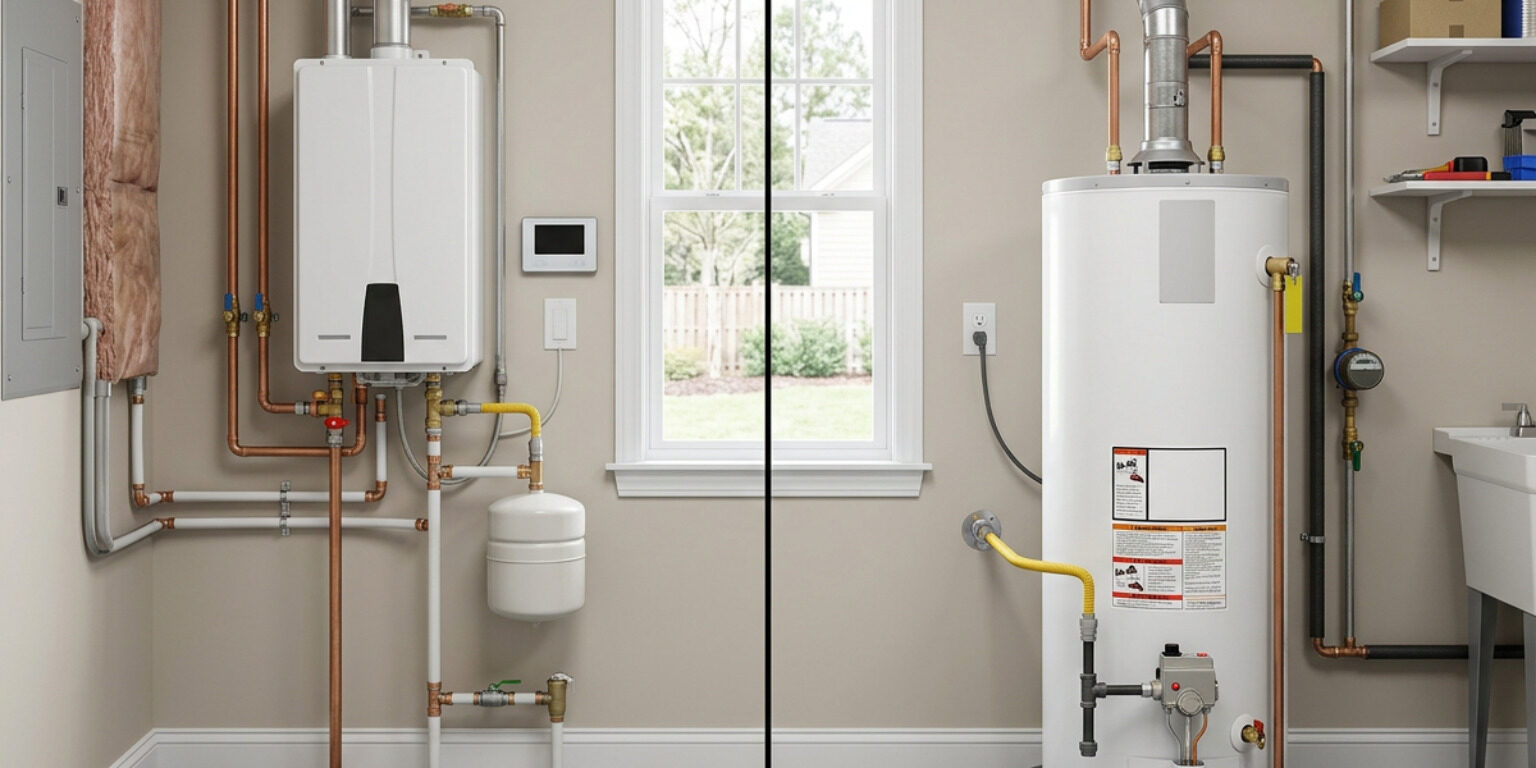
To make an educated decision for your home, it helps to understand how these two systems operate under the hood. While both are designed to deliver hot water to your taps, they go about it in completely opposite ways.
Traditional tank water heaters are the standard systems most of us grew up with. These units continuously heat and store a large volume of water, typically between 40 and 60 gallons, in a heavily insulated metal tank. Because the water sits in the tank waiting to be used, the burner or heating elements must cycle on and off periodically to keep the water at your set temperature. This constant cycling leads to standby energy loss, which means you are paying to heat water even when you are asleep or away at work.
In contrast, tankless water heaters utilize on-demand heating technology. These compact units do not store any hot water. Instead, when you turn on a hot water tap, cold water flows into the unit, triggering a flow sensor. This sensor activates a powerful gas burner or electric heating element. The water passes through a high-efficiency heat exchanger, warming up instantly to your desired temperature before exiting the unit and traveling to your faucet.
Because they only heat water when you need it, tankless systems completely eliminate standby energy loss. However, they do have flow rate limits. While a tank system can dump dozens of gallons of hot water into multiple fixtures simultaneously until the tank runs dry, a tankless system is limited by how many gallons of water it can heat per minute. Homeowners comparing replacement options can also learn more about the best types of water heaters for residential use and how each system fits different household needs.
Choosing the right technology comes down to balancing your daily hot water demand against your long-term energy goals. If you have a large family trying to run multiple showers at the exact same time, a single tankless unit might struggle to keep up with the flow rate, whereas a traditional tank will provide plenty of pressure until its stored volume is depleted.
Upfront Costs vs. Long-Term Savings in South Carolina
When evaluating tankless vs tank water heater Lexington, the financial comparison is often the deciding factor for local families. The upfront investment for these systems varies significantly, but it is important to look at both the initial purchase price and the long-term operational costs to understand the true return on investment.
Traditional tank water heaters are usually more budget-friendly when it comes to the initial purchase and installation. Because the infrastructure for tank systems is already present in most Lexington, SC homes, replacing an old tank with a new one is often a straightforward job. The entire process can usually be completed in just a few hours.
On the flip side, upgrading to a tankless water heater requires a more substantial upfront investment. The units themselves are more technologically advanced than traditional tanks. Additionally, the installation process is more complex. If you are retrofitting a tankless system into a home that previously used a tank model, your plumbing team will likely need to make several structural adjustments. These can include upgrading your gas lines to support a higher British Thermal Unit input, modifying your electrical panel, and installing new dedicated PVC venting through an exterior wall.
Despite the higher initial investment, tankless systems offer strong long-term savings on monthly utility bills. According to the U.S. Department of Energy, tankless water heaters can be up to 34% more energy efficient than traditional storage tank models in homes that use moderate amounts of hot water daily. By eliminating standby heat loss, a tankless unit can also reduce ongoing water heating costs.
Over the lifespan of the system, these monthly savings begin to offset the initial installation premium. The average payback period for a tankless water heater varies based on household hot water use, installation requirements, and local energy rates. If your current system is failing and you need emergency assistance, professional water heater repair in Lexington, SC can help buy you some time while you weigh these financial options.
Lifespan, Durability, and Maintenance Requirements
A water heater is a major household investment, so it is only natural to want a system that is built to last. When comparing the durability and lifespan of these two systems, tankless technology has a clear advantage.
Traditional storage tank water heaters have a typical lifespan of 8 to 12 years. Because they constantly hold water, the interior metal of the tank is subject to continuous rust, corrosion, and sediment accumulation. To combat this, tank heaters contain a sacrificial anode rod, which attracts corrosive elements in the water so they eat away at the rod instead of the tank lining. Once this anode rod is completely depleted, the tank itself will begin to rust, eventually leading to a serious leak or tank burst.
Tankless water heaters, however, routinely last 20 years or more when they receive proper care. Because they do not store water, they are far less susceptible to rust and physical degradation. This extended longevity makes them a highly attractive option for homeowners who plan to stay in their properties for the long haul.
However, a longer lifespan does not mean these systems are completely maintenance-free. Both types of water heaters require regular upkeep to perform at their best:
- Tank Water Heaters: To maximize the lifespan of a traditional tank, you should have it flushed annually to remove the heavy sediment that settles at the bottom. Additionally, the sacrificial anode rod should be inspected every few years and replaced when it is worn down.
- Tankless Water Heaters: Because water is heated instantly inside a compact heat exchanger, high temperatures can cause minerals to drop out of suspension and cling to the internal copper coils. This process, known as scaling, acts as an insulating barrier that forces the burner to work harder, eventually damaging the unit. To prevent this, tankless systems require an annual descaling flush using a mild food-grade acid or vinegar solution to keep the heat exchanger clean.
Failing to maintain your equipment can lead to premature failure and costly repairs. To keep your system running smoothly, our team often recommends regular maintenance and practical homeowner education, including tips on how to maintain your water heater so sediment and scale do not shorten the life of the system.
Installation Space and Placement Considerations
Space is a premium commodity in many modern homes. If you are struggling with limited storage, the physical size of your water heater can play a massive role in your final decision.
Traditional tank water heaters are incredibly bulky. A standard 50-gallon tank usually stands around 60 inches tall and measures roughly 24 inches in diameter. Because of these massive dimensions, tank heaters require a dedicated floor footprint. They are typically installed in garages, basements, utility closets, or attics. This physical footprint is completely lost to storage, and if your water heater is located in a central hall closet, it can take up valuable square footage that could otherwise be used for household organization.
Tankless water heaters are incredibly compact by comparison. A typical residential tankless unit is about the size of a carry-on suitcase, measuring roughly 28 inches tall, 20 inches wide, and only 10 inches deep. Because they are so small and lightweight, these units are designed to be mounted directly to a wall.
This wall-mounted design frees up valuable floor space, allowing you to reclaim your basement or utility closet for other uses. Furthermore, because they do not store water, there is zero risk of a massive 50-gallon flood if the unit suffers a critical failure. This makes tankless systems highly versatile, as they can be safely installed in tight spaces like crawlspaces, small pantries, or even inside bathroom cabinets.
However, you must still carefully plan for proper ventilation and clearances. Gas-fired tankless units require specialized venting to safely exhaust combustion gases outside, which can limit where they can be placed on your walls. If you are trying to figure out the best layout for your home, take some time to read about where to place your water heater tank to maximize both safety and performance.
Performance in Lexington, SC: Climate and Water Quality
To truly understand how a water heater will perform in your home, you have to look at local environmental factors. In Lexington, SC, our climate and groundwater conditions have a direct impact on both tank and tankless systems.
First, let’s talk about groundwater temperature. The temperature of the water entering your home from the municipal supply or a private well dictates how hard your water heater has to work. During the hot South Carolina summers, our groundwater is relatively warm, meaning your system only needs to raise the temperature by a few dozen degrees to reach a comfortable shower level.
However, during our chilly winter months, groundwater temperatures drop significantly. For a tankless water heater, a lower incoming water temperature means it must work much harder to achieve the necessary temperature rise. If a tankless unit is undersized, you might notice a slight drop in water pressure or flow rate during the winter as the system slows down the water flow to ensure it reaches the target temperature.
The second major local factor is water quality. Many neighborhoods in Lexington, SC and surrounding areas like Irmo, SC and Chapin, SC contend with hard water. Hard water contains elevated levels of calcium and magnesium minerals. When this water is heated, these minerals crystallize and settle out of the water.
In a traditional tank heater, this mineral sediment settles to the bottom of the tank, forming a thick, crusty layer over the burner. This layer insulates the water from the heat source, causing the tank to overheat, make loud popping noises, and eventually crack.
In a tankless unit, hard water causes scale to build up rapidly inside the narrow passages of the heat exchanger, restricting water flow and causing the system to overheat. If you live in an area with particularly hard water, installing a whole-home water softener alongside your water heater is highly recommended to protect your investment. When a system is already showing age, recurring leaks, rusty water, or poor recovery, it may be time to evaluate when to replace your water heater before an unexpected breakdown leaves your household without hot water.
Making the Decision: Which System Fits Your Household?
Choosing between a tankless vs tank water heater Lexington is not about finding the single “best” system on the market. Instead, it is about finding the system that perfectly aligns with your household’s size, daily routines, and financial goals.
Sizing Your System: Tankless vs Tank Water Heater Lexington
To size a traditional tank water heater, you look at its overall gallon capacity and its first-hour rating, which measures how much hot water the unit can deliver in a single hour of continuous use starting with a full tank. For most average-sized families in Lexington, SC, a 40 to 50-gallon tank is usually sufficient to handle daily demands.
Sizing a tankless water heater is entirely different. Because there is no stored water, capacity is measured in gallons per minute (GPM). To size a tankless unit correctly, you must calculate your household’s peak hot water demand. This is done by adding up the flow rates of all the fixtures and appliances you might want to run at the exact same time. For example:
- A standard shower head uses about 2.0 to 2.5 GPM.
- A washing machine uses about 1.5 to 3.0 GPM.
- A kitchen sink faucet uses about 1.5 to 2.2 GPM.
- A dishwasher uses about 1.0 to 2.0 GPM.
If you have a busy household where someone is often showering in the master bathroom while the dishwasher is running and another family member is washing clothes, your peak demand could easily reach 6.0 GPM or higher. You will need to select a tankless unit that can comfortably deliver that flow rate at our local winter groundwater temperatures. If your peak demand is exceptionally high, a single tankless unit may not be enough, and you might need to install multiple units in parallel to handle the load.
Long-Term Investment: Tankless vs Tank Water Heater Lexington
If you plan to live in your Lexington, SC home for the next several decades, investing in a tankless system is a highly logical choice. The combination of a 20+ year lifespan, lower monthly utility bills, and the security of knowing you will never run out of hot water during a long shower provides peace of mind. For homeowners ready to compare options with a licensed plumbing team, Franklin Plumbing & Drain Cleaning can help with professional tankless water heater service that accounts for your home’s layout, gas supply, water quality, and household demand.
On the other hand, if you plan to relocate or sell your home within the next few years, a traditional tank water heater is often the more practical financial decision. Because the payback period for a tankless system can take a decade or more, you likely won’t stay in the home long enough to recoup the higher upfront installation costs through utility savings. In this scenario, a high-efficiency tank model will keep your initial costs low while still providing reliable hot water for the remainder of your time in the home.
Additionally, keep an eye out for financial incentives. Many high-efficiency tankless water heaters may qualify for federal tax credits under the Energy Efficient Home Improvement Credit when they meet the required efficiency standards. Local South Carolina utility companies may also offer rebates for homeowners who upgrade from electric tank systems to natural gas tankless models.
Frequently Asked Questions About Water Heaters in Lexington, SC
FAQ 1: How long do tankless water heaters last compared to tank models?
Tankless water heaters generally last 20 years or more with proper maintenance, which is roughly double the lifespan of traditional storage tank models. Traditional tank water heaters typically last between 8 and 12 years before the tank corrodes and requires replacement.
FAQ 2: Is a tankless water heater worth the investment in Lexington, SC?
For many homeowners, yes. While the upfront installation cost is higher, a tankless water heater can reduce your water heating bills by up to 50% and last twice as long as a tank model. However, if you plan to move in the near future, a traditional tank may be a more cost-effective choice.
FAQ 3: What maintenance does a tankless water heater require?
Tankless water heaters require an annual descaling flush to remove mineral scale and sediment from the copper heat exchanger. This is especially important in Lexington, SC, where hard water can quickly build up inside the unit and reduce its overall heating efficiency.
FAQ 4: Can a tankless water heater freeze during South Carolina winters?
Most modern outdoor-mounted tankless water heaters come equipped with built-in freeze protection heaters designed to protect the unit down to temperatures well below freezing. However, during extreme winter weather or power outages, proper insulation and draining are essential to prevent damage.
FAQ 5: How does hard water affect water heaters in Lexington, SC?
Hard water contains minerals that settle out when heated. In tank models, this creates a thick layer of sediment that insulates the heating element and causes the tank to overheat. In tankless models, it creates scale that clogs the heat exchanger, reducing water flow and efficiency.
FAQ 6: Do tankless water heaters provide instant hot water?
No, tankless water heaters provide endless hot water, but not instant hot water. There is still a brief lag time as the unit fires up and pushes the cold water out of the pipes between the heater and your faucet.
FAQ 7: Can I replace a tank water heater with a tankless model?
Yes, you can retroactively convert your home to a tankless system. However, the process usually requires modifying your existing plumbing lines, upgrading gas lines or electrical panels, and installing a new ventilation system to safely exhaust combustion gases.
FAQ 8: Are there tax credits or rebates for upgrading to tankless in 2026?
Yes, in 2026, many Energy Star certified tankless water heaters are eligible for federal tax credits that can offset a portion of the installation costs. Some local utility companies in the Midlands also offer rebates for switching to energy-efficient gas models.
FAQ 9: How do I choose the right size tankless water heater for my home?
Sizing is based on your household’s peak hot water demand, measured in gallons per minute (GPM), and the required temperature rise. You must calculate the flow rates of all fixtures you plan to run simultaneously and choose a unit that can handle that combined demand.
FAQ 10: Why is my tankless water heater experiencing a cold water sandwich?
A cold water sandwich occurs when you turn a faucet off and back on quickly. The heater shuts down briefly, leaving a small pocket of unheated water in the plumbing line between two segments of hot water. Modern tankless units are designed with advanced sensors to minimize this effect.
Conclusion
Deciding between a tankless vs tank water heater Lexington is a significant choice that impacts your home’s comfort, energy efficiency, and long-term utility costs. Whether you prefer the affordable simplicity of a traditional tank or the endless hot water and space-saving design of a modern tankless system, the key to a successful upgrade lies in professional installation.
At Franklin Plumbing & Drain Cleaning, we are dedicated to helping Lexington, SC families find the perfect water heating solutions for their unique needs and budgets. Our team of fully licensed, experienced technicians stands behind all of our work with a 100% satisfaction guarantee. We proudly serve homeowners throughout the Midlands, including Columbia, SC, West Columbia, SC, Irmo, SC, and Chapin, SC.
Whether you need fast repairs on your current system, routine seasonal maintenance, or a complete high-efficiency system replacement, our professional team is ready to help. Franklin Plumbing & Drain Cleaning makes it easy to contact our professional water heater technicians for help choosing, repairing, or replacing the right system for your home.

professional
drain cleaning

highly
recommended

through
repairs

quality
work