
Commercial Leak Detection Strategies Every Property Manager Needs
Home »

Commercial Leak Detection: Why Early Mitigation Protects Your Bottom Line
Commercial leak detection combines automated point sensors, continuous line telemetry, and non-invasive acoustic diagnostics to identify hidden plumbing breaches before they cause catastrophic structural damage or business disruption. Early mitigation through continuous monitoring, automated motorized shutoff valves, and prompt plumbing intervention stops water migration, mold growth, and costly insurance claims across facilities.
Commercial real estate represents a massive capital investment. Whether you manage a sprawling office complex in Columbia, an industrial park in West Columbia, or a multi-tenant retail plaza in Lexington, unaddressed water intrusion threatens structural integrity and tenant relationships. Water damage remains one of the single largest drivers of commercial property loss claims, often resulting in prolonged business disruption and costly remediation.
When water quietly pools behind drywall or underneath commercial concrete foundations, structural decay begins long before anyone spots a puddle. Moisture rots subfloors, rusts steel framing studs, compromises structural load capacities, and cultivates hazardous mold within 24 to 48 hours according to the Environmental Protection Agency. The operational downtime required to tear out wet building materials disrupts daily business, leading to lost revenue and potential tenant lease disputes.
Proactive monitoring stops minor plumbing anomalies from turning into full-scale building disasters. In many facilities, the earliest indicator of a hidden leak is not a dripping ceiling tile, but rather unexplained spikes on utility bills that point to constant, unmetered water loss deep within the plumbing lines.
Primary Causes of Water Infiltration in Commercial Facilities
Commercial plumbing networks endure heavy, continuous strain. Unlike residential settings, commercial buildings handle massive hydrostatic pressures, complex multi-story vertical risers, and varying demand loads across hundreds of fixtures.
Common culprits behind commercial water intrusion include:
- Aging Infrastructure and Piping Degradation: Over time, mechanical wear, pressure surges, and scale buildup weaken municipal tie-ins and internal distribution lines. Copper supply lines can suffer internal pitting, making it essential to identify corrosion and pinhole leaks in copper pipes before a pressurized rupture occurs.
- HVAC Condensate Overflow: High-capacity rooftop units, chillers, and AC air handlers generate gallons of condensation daily. Blocked drain lines cause drain pans to overflow directly into ceiling plenums, damaging ceiling tiles and tenant offices below.
- Chiller and Boiler Line Stress: Closed-loop hydronic heating and cooling systems operate under significant thermal expansion and vibration. Flanges, expansion joints, and valve packings can weep continuously without immediate detection.
- Building Envelope Failure: Wind-driven rain, roof membrane punctures, degraded window caulking, and compromised expansion joints let rainwater infiltrate multi-story exterior walls.
- Construction and Renovation Defects: Poorly soldered fittings, unseated pipe joints, and abandoned water lines from historical tenant upfits can fail unexpectedly when full system pressure is restored.
Financial Impacts, Insurance Claims, and Builder’s Risk Reduction
The financial fallout of a commercial water incident extends far beyond a local plumbing repair bill. The average commercial water loss claim reaches tens of thousands of dollars, with multi-floor high-rise flooding reaching into the hundreds of thousands in structural dry-out, electrical replacement, and mold remediation expenses.
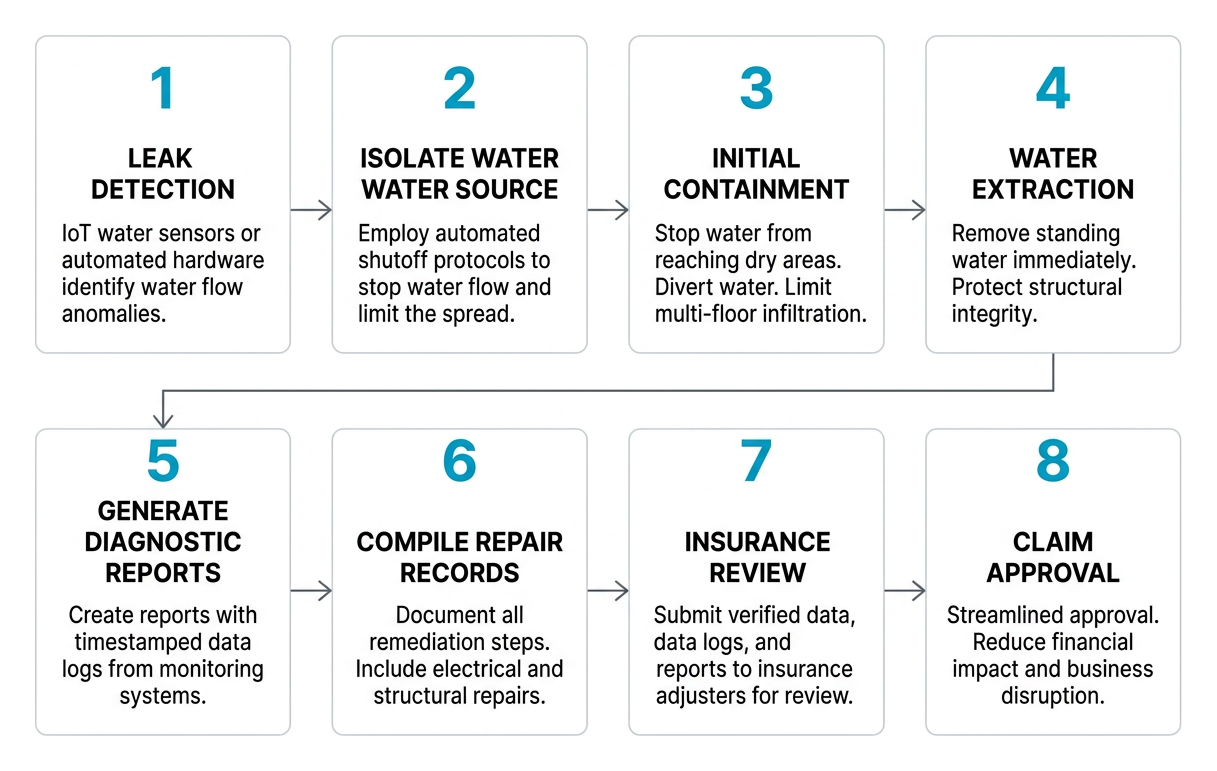
Commercial property insurance carriers increasingly scrutinize water risk profiles. Facilities equipped with automated monitoring hardware and verified shutoff protocols often qualify for lower commercial deductibles and reduced risk premiums.
For general contractors and developers overseeing active construction sites, builder’s risk insurance policies carry hefty deductibles for water damage. Installing temporary IoT water sensors across building risers, utility chases, and newly plumbed floors protects projects during the high-risk fit-out phase. When an incident does occur, modern systems deliver timestamped data logs and diagnostic reports accepted by insurance adjusters, streamlining claim approvals and demonstrating proactive risk mitigation.
Core Monitoring Technologies and Equipment Configurations
An effective leak mitigation plan relies on layered detection technologies that provide immediate visibility across all mechanical zones. Rather than depending on manual walk-throughs by maintenance staff, facilities implement automated sensor networks that track moisture, line pressure, and total flow.
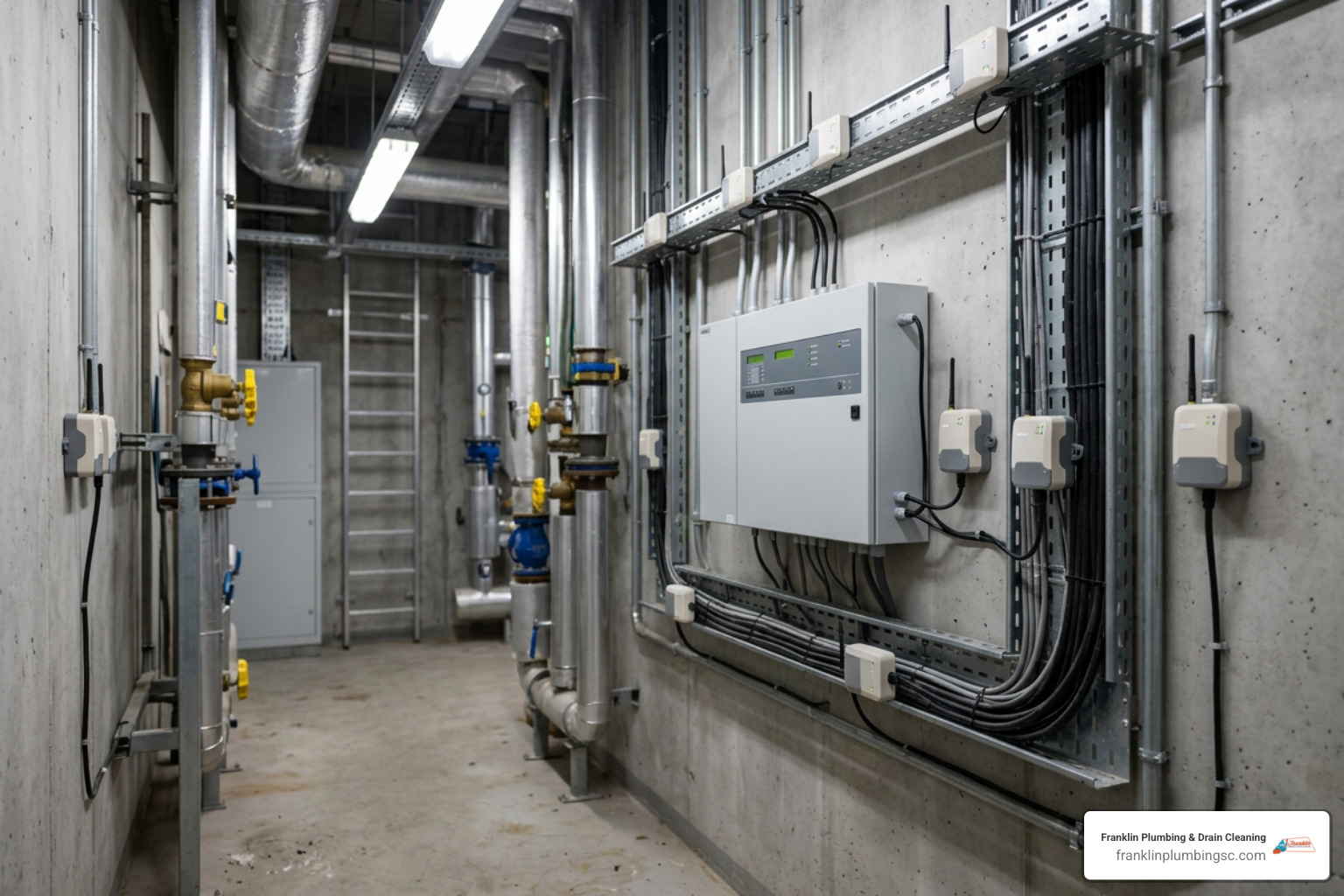
Modern Commercial Leak Detection Systems: Spot, Rope, and Flow Devices
Commercial facilities use three primary categories of water detection hardware:
- Point Spot Detectors: Compact sensors placed directly on flat surfaces where water is expected to pool first, such as water heater catch pans, chiller drip trays, and underneath sink vanities. These sensors use dual gold-plated probes; when pooled liquid bridges the contact points, the electrical circuit completes and triggers an alarm.
- Conductive Sensing Ropes and Cables: Flexible conductive cables run around the perimeter of critical rooms, along refrigeration lines, or beneath raised flooring tiles in computer rooms. Sensing cables detect liquid anywhere along their entire length, making them suitable for expansive open zones and horizontal pipe runs.
- Continuous Flow and Ultrasonic Telemetry: Inline turbine meters and non-invasive ultrasonic flow sensors clamp onto primary incoming supply mains. These monitors learn your facility’s baseline flow patterns, tracking continuous water consumption during off-hours to identify slow hidden leaks, stuck flush valves, or sudden main breaks.
When linked to automated motorized ball valves, these systems instantly isolate supply risers the moment anomalous flow or perimeter moisture is detected, stopping water spread in seconds.
Comparing Wireless IoT Sensors and Traditional Hardwired Systems
Choosing between wireless IoT sensors and hardwired systems depends on your building’s architecture, whether the project is a new build or a retrofit, and overall budget constraints.
| Feature / Metric | Wireless IoT Sensor Networks | Traditional Hardwired Systems |
|---|---|---|
| Installation Complexity | Low; surface mount with adhesive or brackets | High; requires running conduit and wiring through walls |
| Retrofit Suitability | Excellent for occupied, historic, or existing buildings | Difficult and disruptive to finish surfaces |
| Power Supply | Long-life lithium batteries (3 to 7-year life) | Low-voltage direct power with centralized UPS backup |
| Communication Protocol | LoRaWAN, Zigbee, or Cellular Gateways | Direct dry-contact wiring, RS-485, Modbus |
| BMS Integration | API, Cloud integrations, or local gateway relays | Direct BACnet / hardwired relay panel inputs |
| Scalability | Easy; add modular sensors instantly | Requires pulling additional wiring back to panels |
| Standards & Approvals | FM Standard 7745 certified models available | FM Standard 7745 certified industrial panels |
Non-Invasive Diagnostic Tools: Acoustic, Thermal, and Tracer Gas
Locating a leak behind concrete or deep inside a plumbing chase without tearing apart finished construction requires specialized diagnostic tools:
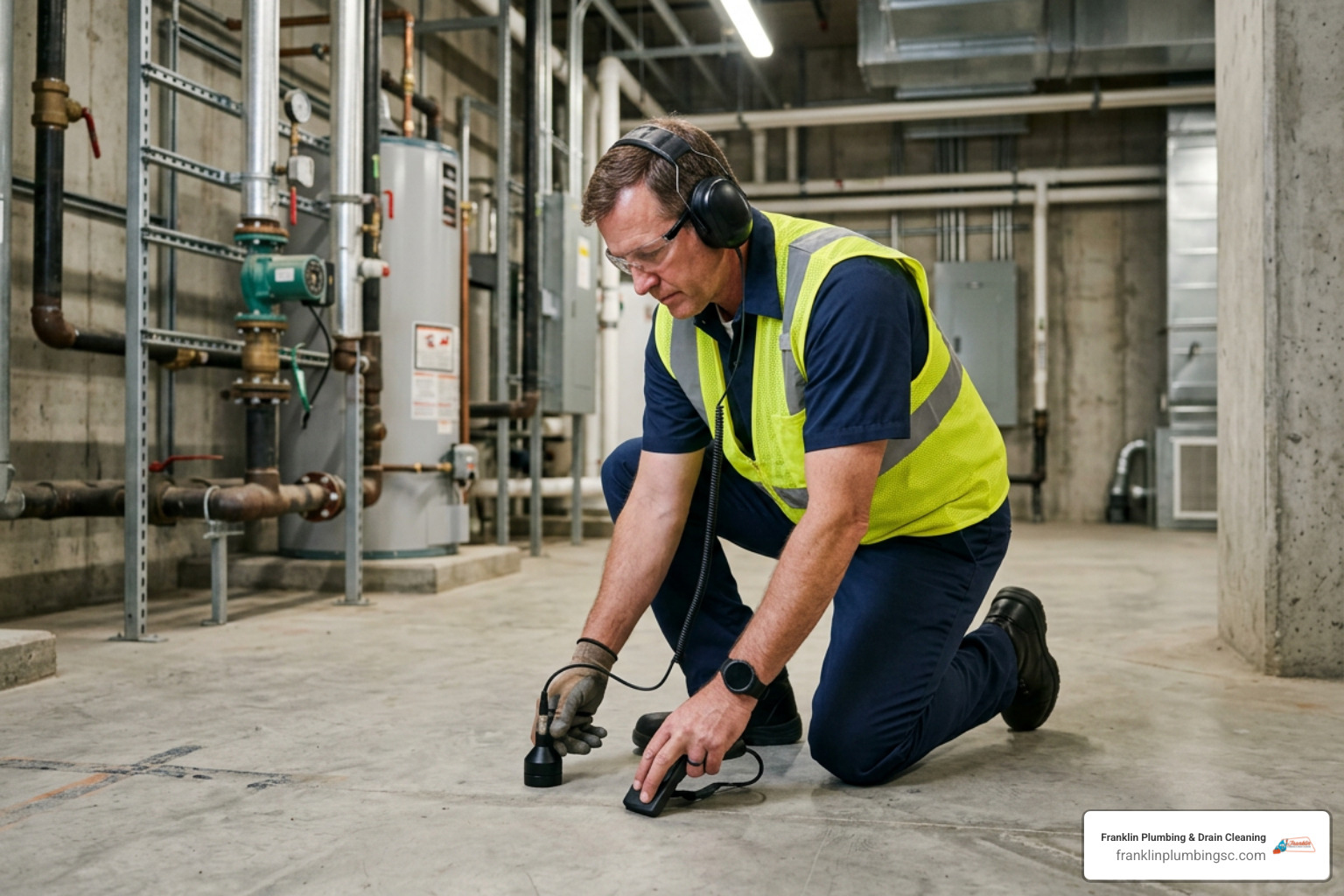
- Acoustic Listening Devices and Ground Microphones: Pressurized water escaping through a cracked pipe creates distinct acoustic frequencies. Technicians use amplified acoustic ground microphones and correlation loggers to pinpoint the exact location of sub-slab leaks through inches of solid concrete.
- Infrared Thermography: Thermal imaging cameras detect minute temperature variances (down to 0.1°C) on wall and ceiling surfaces. Evaporating moisture and hot or cold water pipe leaks alter surface thermal signatures, revealing hidden water paths without drilling exploratory holes.
- Tracer Gas Leak Detection: For low-pressure lines or closed hydronic loops, technicians introduce an inert, non-toxic nitrogen-hydrogen tracer gas mix into the line. The microscopic gas molecules escape through the pipe fissure, migrate upward through soil and concrete, and are detected at the surface using sensitive gas sniffer probes.
- Hydrostatic Pressure Decay Testing: Isolating specific pipe segments with test plugs and monitoring pressure gauges determines whether a sealed line holds constant pressure or has an active breach.
Strategic Sensor Placement and System Integration
Placing sensors effectively ensures high-risk zones are covered while avoiding false alarms from everyday cleaning routines.
Identifying High-Risk Zones and Vulnerable Equipment
Target sensor deployment across these business-critical areas:
- Mechanical Rooms and Utility Risers: Install spot detectors beneath water heaters, booster pumps, backflow preventers, and main shutoff manifolds.
- Server Rooms and Data Closets: Run conductive sensing ropes around room perimeters and underneath raised flooring to protect costly IT racks, networking hardware, and power distribution units from overhead condensation or exterior wall seepage.
- Commercial Kitchens and Break Rooms: Position spot sensors under dishwashers, ice machines, walk-in cooler evaporators, and multi-line beverage dispensing stations.
- HVAC Air Handling Units and Chiller Loops: Place sensing cables along condensate drain pans and below ceiling-mounted fan coil units to stop leaks before they stain ceiling tiles.
- Restroom Battery Walls and Pipe Chases: Secure sensors behind fixture carrier assemblies to catch hidden valve packing failures and supply line drips.
- Building Perimeters and Slabs: Monitor ground-level utility penetrations to catch early foundation and slab leak symptoms before moisture damages finished flooring.
Integrating Leak Sensors with Building Management Systems (BMS)
Commercial properties operate more smoothly when mechanical alarms feed into a central monitoring interface. Modern leak detection networks communicate directly with Building Management Systems via BACnet MS/TP, BACnet IP, or Modbus protocols.
Integrating sensors into your BMS enables powerful automated workflows:
- Instant Zone Isolation: The BMS receives a leak signal from a third-floor sensor and automatically commands the motorized zone valve on that riser to close, isolating the leak while maintaining water service to the rest of the facility.
- Coordinated Mechanical Shutdowns: If a leak is detected beneath an AC air handler or server room cooling unit, the BMS shuts down the circulating pump to stop condensate production and protect electronic hardware.
- Automated Escalation: Alert triggers instantly notify on-duty facility engineers via SMS, send high-priority emails to property management, and log the incident timestamp for compliance records.
Best Practices for Operational Response and Vendor Selection
Hardware installation is only half the battle. Your operational staff and maintenance vendors must know how to respond swiftly when an alert sounds.
Establishing Rapid Incident Response and Shutoff Workflows
Every commercial facility should maintain a clear, written water response plan accessible to property managers, building engineers, and security personnel.
- Verify the Alert: Check your BMS dashboard or cloud console to identify the exact room, riser, and sensor ID generating the alarm.
- Perform Visual Assessment: Dispatch on-site personnel immediately to look for subtle signs of a hidden water leak or pooling water.
- Execute Manual or Remote Isolation: If automated shutoff valves are not installed on that branch, locate the manual quarter-turn isolation valve on the riser diagram and isolate the line immediately.
- Determine Emergency Severity: Quickly evaluate the situation using standard operational protocols for evaluating when a pipe leak is an urgent emergency to coordinate emergency remediation teams and minimize structural damage.
- Notify Affected Tenants: Send clear communication updates to impacted tenants regarding water service disruptions and estimated restoration times.
Training Staff on Commercial Leak Detection Protocols and Incident Escalation
False alarms cause alert fatigue, which can lead staff to ignore real warnings. Proper training ensures the system operates reliably:
- Custodial Protocol Alignment: Train janitorial teams to avoid soaking spot sensors during routine floor scrubbing and mopping, or configure a brief 15 to 30-second alarm delay on floor-mounted sensors in public restrooms.
- Quarterly Hardware Drills: Conduct scheduled drills where technicians manually trip test sensors to verify that automated shutoff valves actuate smoothly and BMS notifications reach on-call personnel.
- Battery Maintenance Schedules: Establish a systematic battery replacement program for all wireless IoT transmitters every three to five years, rather than waiting for low-battery telemetry alerts.
Selecting the Right Commercial Plumbing and Detection Partner
Partnering with an experienced commercial plumbing contractor for commercial leak detection services ensures your infrastructure is correctly engineered, installed, and supported.
Look for these qualifications when selecting a vendor:
- Commercial-Scale Diagnostics: Ensure the contractor uses non-invasive acoustic, thermal, and tracer gas locating tools that identify line breaks without requiring exploratory wall demolition.
- As-Built Blueprint Review: A qualified team reviews mechanical as-built drawings and riser schematics to locate hidden tie-ins, dead legs, and isolation valves before beginning work.
- Broad Mechanical Diagnostics: Choose a team capable of diagnosing complex system issues, whether locating concealed sub-slab leaks or troubleshooting low water pressure issues caused by hidden line restrictions or underground main failures.
- Flexible Scheduling: Select a commercial partner that offers scheduled access windows during off-peak hours, allowing critical water line testing without interrupting tenant operations.
Frequently Asked Questions About Facility Water Management
What is commercial leak detection and how does it work?
Commercial leak detection is an integrated monitoring process that uses physical sensors (spot detectors, sensing cables) and continuous inline flow telemetry to locate water leaks. When moisture touches a sensor or flow exceeds normal thresholds, the system triggers alerts and can automatically close motorized valves to isolate the water supply.
How do commercial leak detection services differ from residential plumbing in Columbia, SC?
Commercial systems involve higher water volumes, larger pipe diameters (often 2 to 4 inches or more), multi-tenant zoning, and vertical utility risers. Franklin Plumbing & Drain Cleaning provides dedicated professional commercial leak detection services in Columbia, SC tailored to the demands of commercial buildings, retail centers, and industrial facilities.
Can commercial leak detection be performed without shutting down facility operations?
Yes. Modern diagnostic methods such as infrared thermography, acoustic listening discs, and ultrasonic clamp-on flow metering allow technicians to pinpoint leaks while building operations continue normally without interrupting water service to tenants.
How much can leak detection systems save on commercial property insurance?
Commercial property insurers often offer premium discounts and lower water damage deductibles for buildings equipped with continuous leak monitoring and automatic shutoff systems. These systems also significantly reduce out-of-pocket costs for property dry-out and structural repairs.
What is the difference between point spot detectors and sensor ropes?
Point spot detectors monitor localized surfaces directly beneath specific equipment like water heaters or chiller pans. Sensing ropes use conductive cables that detect moisture along their entire length, making them better suited for perimeter monitoring in server rooms, under raised floors, or along long pipe chases.
How quickly do automatic shutoff valves isolate a commercial water leak?
Motorized ball valves close within 5 to 30 seconds of receiving a signal from a water sensor or flow monitor. This rapid response stops pressurized water discharge before it can pool, migrate across floors, or penetrate electrical chases.
How do wireless leak detectors communicate with building management platforms?
Wireless sensors transmit low-frequency radio signals (such as LoRaWAN) to a centralized on-site gateway. The gateway translates these signals into standard BMS protocols like BACnet or Modbus, or sends data to cloud dashboards via cellular or Ethernet connections for real-time alerting.
Where are the most critical areas to place leak sensors in multi-story buildings?
The most critical locations include mechanical penthouses, rooftop HVAC units, domestic hot water boiler rooms, main plumbing risers, elevator pits, data server rooms, and commercial kitchens located on upper floors above tenant spaces.
What routine maintenance is required for commercial leak detection hardware?
Routine maintenance includes cleaning dust and debris from sensor contact pins, replacing wireless transmitter batteries every 3 to 5 years, testing automated valve actuation quarterly, and verifying communication heartbeats between sensors and the central monitoring gateway.
What documentation do commercial insurance adjusters require after a water leak?
Adjusters typically require time-stamped telemetry logs showing when the leak started and stopped, thermal imaging photos documenting the moisture boundary, as-built schematic markups indicating the leak location, and a formal diagnostic report from a licensed commercial plumbing contractor.
Conclusion: Safeguarding Commercial Assets
Water damage is one of the most disruptive and expensive hazards facing commercial property managers, building owners, and general contractors today. Left undetected, minor plumbing failures rapidly escalate into extensive structural damage, toxic mold growth, ruined physical assets, and costly tenant downtime.
Implementing a layered leak detection strategy that combines wireless spot sensors, conductive ropes, continuous flow monitoring, and automated shutoff valves delivers 24/7 protection for your physical plant. By integrating these tools into your Building Management System and training your staff on swift shutoff procedures, you protect your operating budget, reduce insurance risks, and ensure business continuity across your facilities.
At Franklin Plumbing & Drain Cleaning, we help property managers across Columbia, West Columbia, Lexington, Irmo, Blythewood, and the surrounding Midlands protect their facilities with dependable commercial leak detection and plumbing solutions. Our licensed, experienced technicians bring advanced diagnostic tools to every project, backed by our 100% satisfaction guarantee.
Do not wait for a collapsed ceiling tile or an unmanageable water bill to reveal a hidden plumbing failure. Franklin Plumbing & Drain Cleaning is ready to help. Contact our commercial leak detection specialists to schedule a comprehensive assessment and protect your commercial property for years to come.

professional
drain cleaning

highly
recommended

through
repairs

quality
work